Published by i-FM.net

FM: a roadmap for the future


Workplace Futures marked its 20th anniversary with an in-depth look ahead. A panel of exceptionally qualified speakers shared experiences & insights across a range of highly topical issues, including market trends and opportunities, technology, sustainability, FM operations, standards, talent recruitment & development, and much more – all captured here.

i-FM.net
March 2026
© Workplace Futures 2026. All rights reserved.

Our 20th annual conference turned the focus to the future – what are the practices, the people, the organisations, the innovations that are going to transform facilities management, re-invigorate the sector and make it more attractive to the next generation as well as encouraging those with established careers to move across and join us?

How will we define and reinforce our messaging to exemplify the best of what we do and the value that good FM brings to every organisation? How do we improve the storytelling around our deliverables: the customer experiences, the support for wellbeing, the improved efficiencies, the enhanced productivities that flow when the facilities strategy is in harmony with a client’s business strategy and practices?

Facilities management has been on a journey for 40+ years. Workplace Futures 2026 took a hard look at where we’ve come from, where we are currently positioned and – most importantly – where we need to ultimately arrive, exploring the key factors that FM needs to put in place to ensure that it gets there successfully.

This event was particularly timely as we face a period of even more change, and thus even more uncertainty, than usual for FM: numerous ‘chronic’ issues are pressing, technology is developing at an increasingly rapid pace, and traditional business models (including financial models) are being questioned. The underlying theme for 2026 was this: how do we navigate the next few years? In a dynamic market, FM is clearly still a ‘work in progress’. Where has the sector successfully developed and moved forward? What can we learn now that will ensure we do more than survive – that we thrive as a valued strategic partner?

Our expert speakers offered a broad range of valuable, knowledgeable, practical information and insights. There is plenty think about, and act on, here.

With thanks to our sponsors

Introduction

This year, more than anything, felt like a recalibration. Not a conversation about what is coming next, but a discussion about what actually matters now.

Author: Simone Fenton-Jarvis, Director and Co-Founder, The Human-Centric Workplace, and Conference Chair

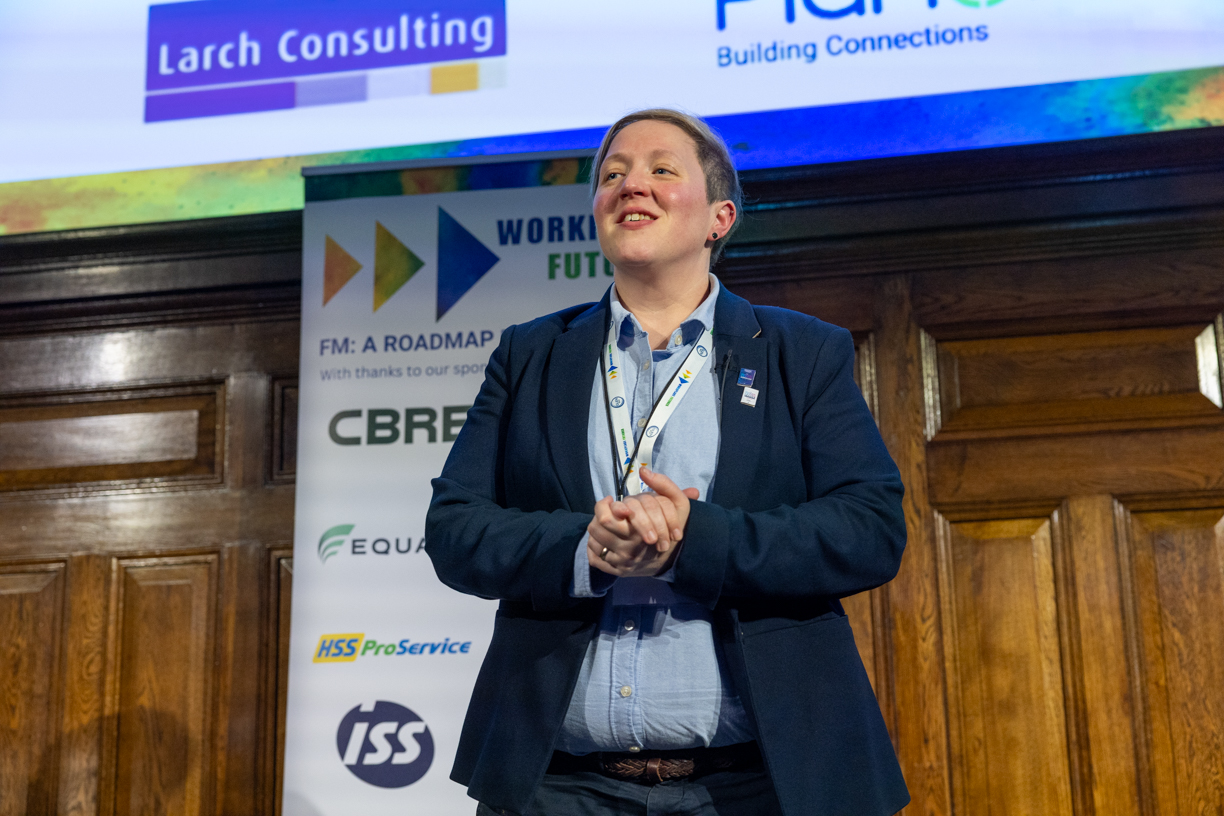
Chairing Workplace Futures is one of those rare days where you get to step back and see the industry in motion. The ideas, the tensions, the ambition, and occasionally the chaos. My role: keep time (or try to), connect the dots, ask the questions, try not to swear (too much) and sheepdog delegates all around for the day!

For the 20th year of Workplace Futures, it was apt that we took on the theme of ‘FM: a roadmap for the future’ - with the aim of popping up some signposts to help companies come up with their own individual roadmaps. This year, more than anything, felt like a recalibration. Not a conversation about what is coming next, but a discussion about what actually matters now.

We tackled a range of big topics throughout the day. Maybe it’s a sign of where the industry – and the world - is at this juncture that there was a heavy emphasis on people. We can all agree that humans are central to the future, but there are of course many more issues to be understood and addressed.

Without capable people, resilience is just a word we put on slides.

Preparing people for an unpredictable future
Dr Mel Bull set the tone early with a little unfreeze and a wobble, adding: “We cannot predict the future, but we can prepare our people for it.”  Because while technology continues to accelerate, capability is not keeping pace.  And without capable people, resilience is just a word we put on slides.

Steve Gladwin brought that into sharp focus. FM does not suffer from a lack of opportunity. It suffers from a lack of capability. We need to stop talking about ‘falling into FM’ and start recognising the value, skills and pathways into it. The apprenticeship levy sits there as a practical lever. Use it or lose it.

James Bradley reinforced this shift. Where once tenure was seen as a proxy for safety and performance, now it is skills, development and continuous learning that matter.

And Simon Wrenn widened the lens further. The FM ecosystem is not linear. It is layered - from new entrants to established leaders. The power sits in exposure, mentoring and creating space for future founders to emerge.

Leadership as critical infrastructure
Louisa Clarke delivered provocation: leadership is not a soft skill; it is critical infrastructure. As technology accelerates, human capacity is being stretched. The risk is not just operational, it is behavioural.

Leadership is not a soft skill; it is critical infrastructure.

Underdeveloped leadership is one of the most significant risks facing FM today. Not because leaders are incapable, but because the expectations placed on them are increasing faster than the support they receive. If we want better outcomes, we need better leadership. Deliberately developed, consistently applied and grounded in the realities of the role.

Technology - useful, but not yet joined up
There was no shortage of discussion about technology. But the tone has changed. Fewer gimmicks and less fascination, but more frustration.

Andrew Targell highlighted a reality many organisations will recognise. Software spend may be reducing, but complexity is increasing. The average employee is spending around 180 hours a year switching between systems. That is not productivity, that is fragmentation.

The answer is not more tools, but better orchestration.

The answer is not more tools, but better orchestration - a ‘city plan’ for technology and data. Something intentional, connected and designed around outcomes rather than layered through procurement cycles.

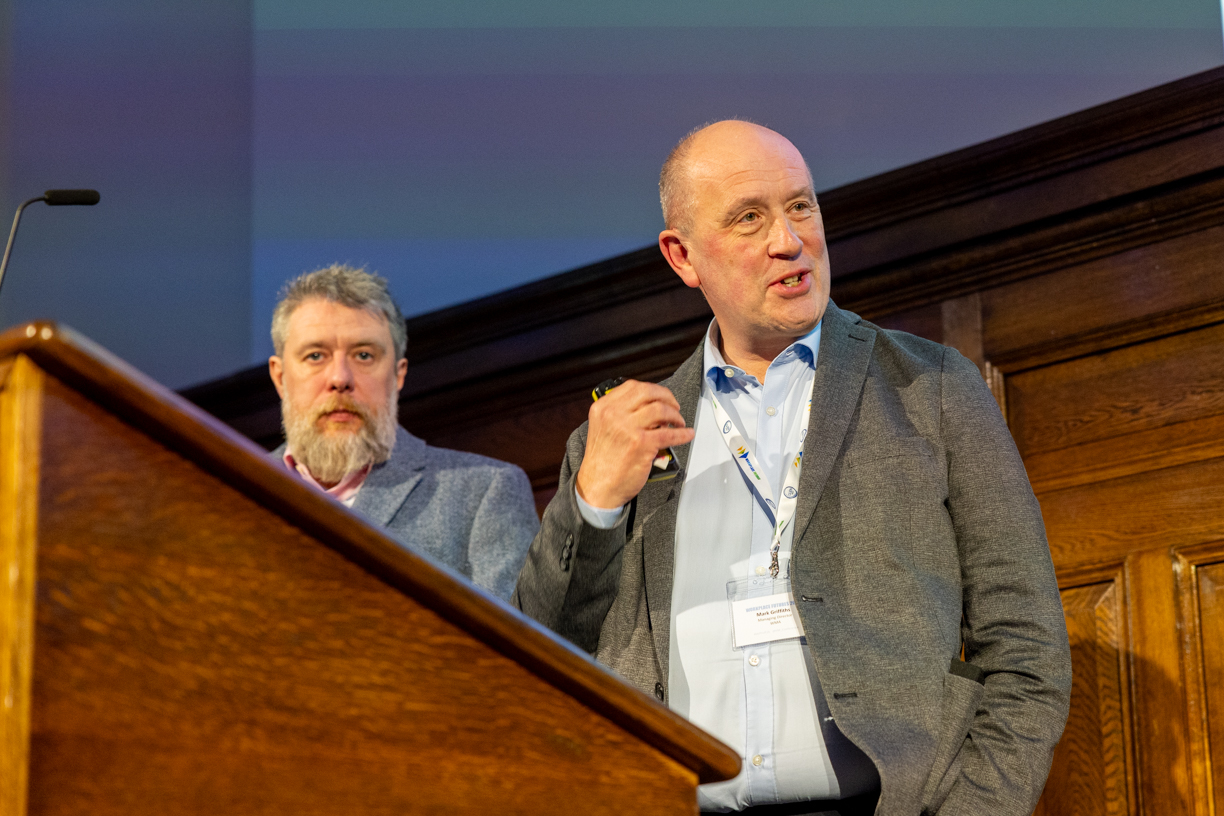
Mark Griffiths and Gordon Mitchell built on this in the context of AI. If there is no clarity of purpose, there will be problems. AI cannot sit as a bolt-on; it has to be embedded into how organisations operate day to day. Or, as it was put on the day, if the workplace is an orchestra, FM is the composer. Without that coordination, all you get is noise.

Outcomes over optics
John Raspin grounded the conversation in economic reality. FM is outperforming the wider economy. Spend is higher than pre-pandemic levels. The opportunity is there, but ‘cool’ technology will not deliver it: outcomes will. That distinction shifts the conversation from what we are buying to what we are achieving.

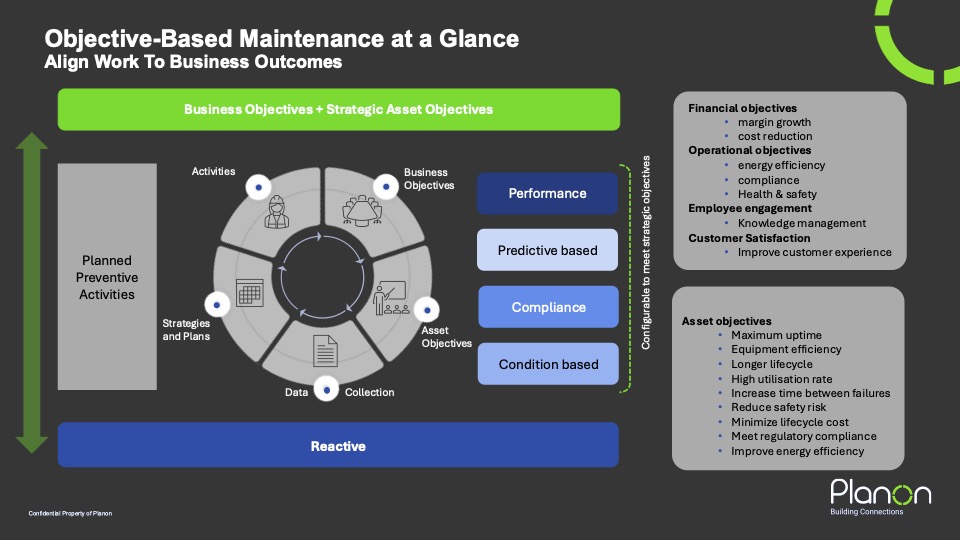
Nush Cekdemir brought this to life through objective-based maintenance. Moving away from one-size-fits-all approaches and towards decisions grounded in what matters most: safety, uptime, cost, sustainability. Not habit or legacy, but intent.

And Claire Atkins Morris and Alexandra Hammond demonstrated how this plays out in practice. Net zero is not just a purpose-driven ambition, it is commercial and requires partnership, clarity and delivery.

Sustainability beyond the noise
Sunil Shah challenged something that sits just outside the industry but shapes it significantly: the narrative. Sustainability has become politicised, simplified and at times divisive. The reality is more complex. And, in many ways, more positive.

FM sits at the centre of decarbonisation. Yet there are missed opportunities to communicate the impact being made. Independent audits, transparency and better storytelling will be critical to avoid greenwashing and build trust.

Opportunity, not evenly distributed
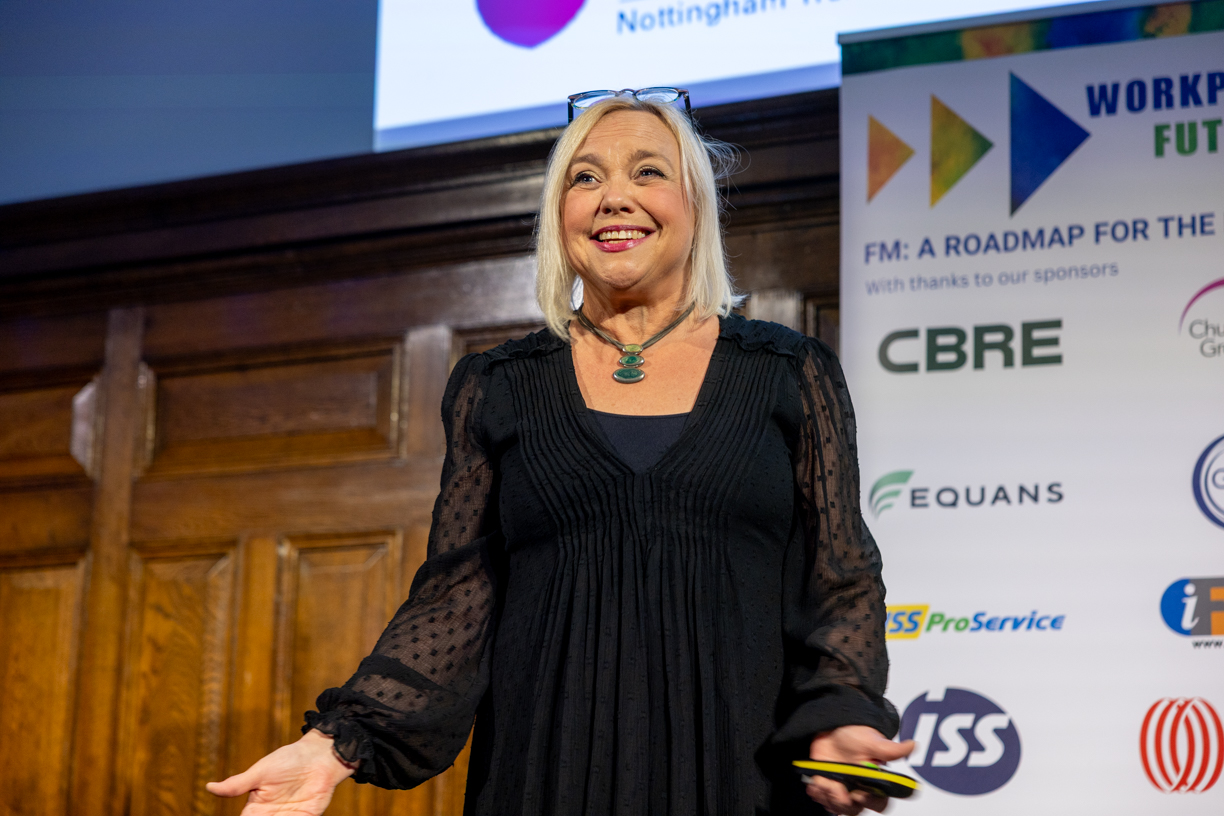
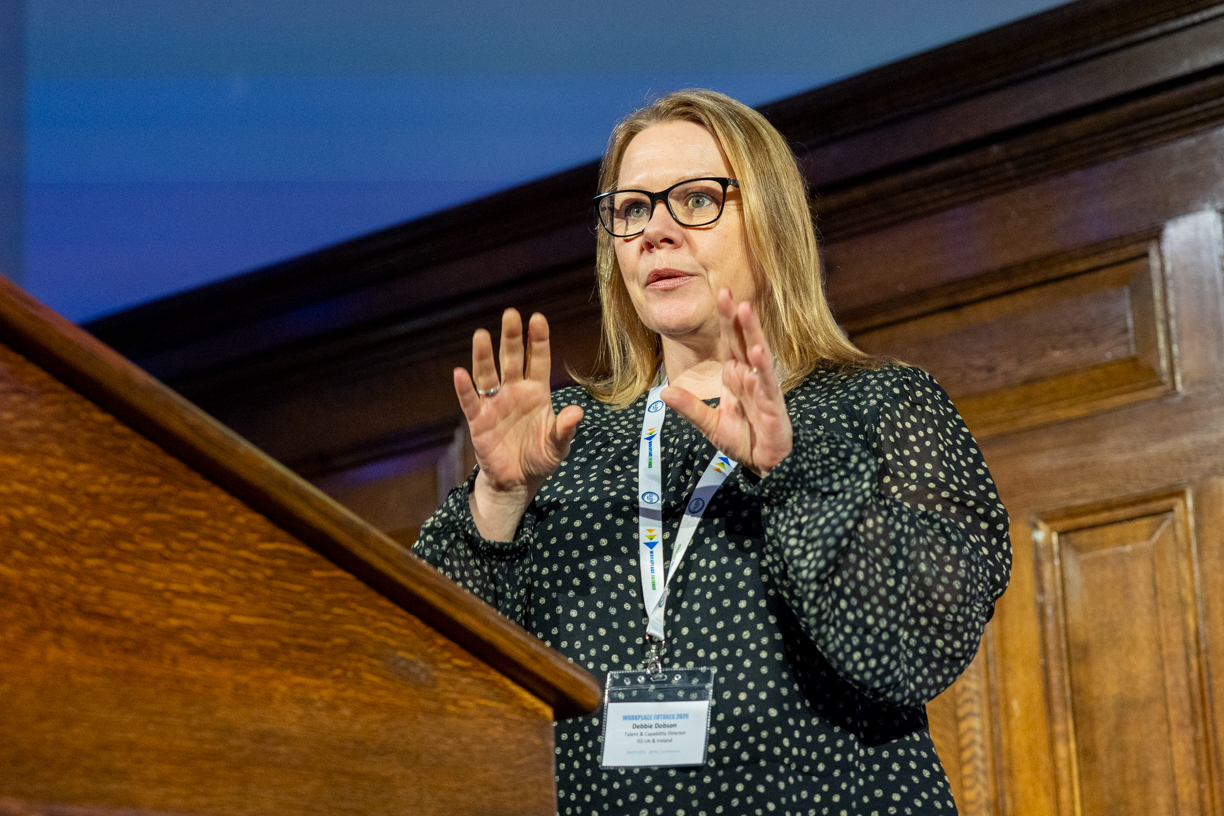
Debbie Dobson closed with a simple but powerful reflection. Potential is everywhere, but opportunity is not.

The role of FM, and the responsibility of leadership, is to remove barriers, create access and enable people to step into that potential. The future of the industry will not be defined by technology alone; it will be shaped by who gets the opportunity to contribute to it.

Potential is everywhere, but opportunity is not.

Innovation is happening
Alongside these insights, the day also celebrated what is already being achieved. Arcus FM were recognised with the 2026 Technology in FM Award, with Equans securing Highly Commended recognition - both a clear reminder that innovation is happening.

And, of course, we were given a glimpse into what great looks like in practice, from Sky Studios to programmes already reshaping how organisations think about their future.

Summing up
If there is one thread that connects everything from Workplace Futures 2026, it is this -

We do not have a shortage of ideas.
We do not have a shortage of tools.
We do not have a shortage of ambition.

What we are being asked to do now is apply all three with greater intent.

To connect what we know, to invest in who we need, and to focus relentlessly on the outcomes that matter.

See you again next year!


Leading the future: human-centred leadership and skills for a world in transition

A human-centred leadership approach drawing on psychological safety and reflective practice provides a vital pathway for building an FM profession capable of meeting the demands of the AI‑enabled, rapidly changing world of work.

Author: Dr Mel Bull, Director of Executive Education and MBA Programmes, Nottingham Business School, Nottingham Trent University

The future isn’t something we step into – it is something we help create. The world of work is undergoing profound transformation driven by artificial intelligence, demographic pressures and shifting employee expectations. These forces are particularly visible in the facilities management sector, where workforce demographics, operational complexity and the rapid adoption of digital technologies are reshaping the skills required of leaders. FM professionals, responsible for creating and sustaining the environments in which organisations function, face increasing demands for strategic, human‑centred leadership. As the Chartered Institute of Personnel and Development (CIPD, 2015) notes, up to 30% of the UK workforce is set to retire by 2035, placing FM, already characterised by an ageing workforce, under heightened pressure.

FM professionals face increasing demands for strategic, human‑centred leadership.

Within this evolving context, human-centred leadership, drawing on reflective practice, creating a strong sense of psychological safety in the organisation and development of a coaching culture, has become central to FM’s future capability. FM leaders need to develop their self‑awareness, emotional intelligence and organisational learning routines required to lead modern FM teams effectively and to continue to thrive in a VUCA world.

The changing world of work: technology, demographics and expectations
AI now functions as an infrastructural component of FM operations. From predictive maintenance and smart‑building analytics to workforce scheduling and space optimisation technologies, AI supports FM professionals in managing increasingly complex estates. However, technology is only as effective as the leadership that supports its adoption. Human‑centred leadership ensures that digital tools align with professional values, staff capabilities and organisational culture.

Technology is only as effective as the leadership that supports its adoption.

Demographic pressures are especially acute in FM. Many estates and FM managers have long service histories and hold significant tacit organisational knowledge, which becomes vulnerable as retirement rates increase.  There needs to be a focus on leadership development within FM which addresses the talent pipeline and encourages development of practitioners to allow organisations to build their resilience through uncertain times.

Employee expectations also shape the FM context. FM teams often work in pressurised, service‑oriented environments where psychological safety, wellbeing and autonomy are vital. SHRM (2025) findings from their 2026 State of the Workplace report emphasised that employees across sectors increasingly seek meaningful work, supportive managers and opportunities to learn, factors particularly relevant to FM roles that rely on collaboration, service delivery and continuous improvement.

Psychological safety, reflective practice and coaching culture
Psychological safety is foundational within FM teams, where operational risks, service pressures and constant change can create anxiety if not managed effectively. Edmondson’s (2019) definition of psychological safety is a climate where individuals can express concerns, admit mistakes and contribute ideas without fear, and this aligns closely with FM’s need for transparent communication and shared learning.

Bull and Stokes (2020) provide rich evidence demonstrating how reflective practice strengthens psychological safety specifically within FM environments. Their research, based on interviews with estates and FM managers, shows that reflective routines help FM teams move away from blame‑oriented cultures - often found in operational, high‑pressure settings - and toward cultures of shared responsibility. FM managers in the study described how reflective discussions enabled them to openly explore service failures, operational issues and interpersonal conflicts in constructive ways.

One estates manager reported that prior autocratic leadership styles in FM had stifled reflection, creating environments where staff felt they ‘had to keep their heads down’. Reflective practice transformed this dynamic by creating structured opportunities to discuss mistakes, explore alternatives and identify improvements. This illustrates how psychological safety is not simply a leadership ideal but an operational necessity within FM, where continuous learning underpins service delivery. FM environments, with their immediate operational demands, can easily fall into cycles of blame, avoidance or ‘fire‑fighting’. Reflective practice counters this by normalising joint learning and enabling continuous improvement with a focus on human-centered leadership.

Employee engagement: evolving drivers
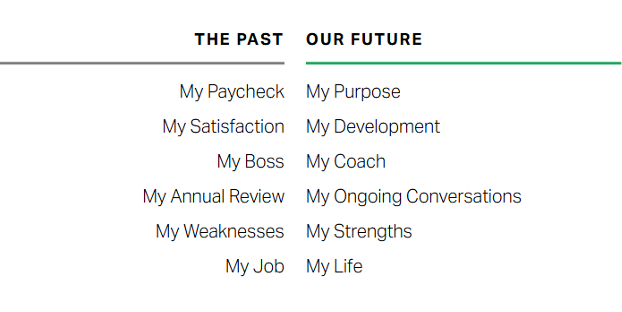
Employee engagement is shaped by relational, developmental and organisational factors, each particularly relevant to FM, where teams must collaborate closely and respond quickly to changing organisational needs. When engaging employees, leaders need to know a key fact about today’s workplace: it has evolved!  Gallup research reveals that to perform at their highest, employees need something different from their work than they used to. Their research highlights that employees increasingly seek purpose, recognition and opportunities for growth as highlighted below (Gallup, 2025).

Leaders need to know a key fact about today’s workplace: it has evolved!

Employee Engagement (Gallup, 2025)

Engage for Success, a voluntary movement promoting employee engagement, further highlights four enablers for engagement including having a strong strategic narrative, having engaging managers who treat people as individuals, employee voice meaning employees are listened to and are invited to contribute their experience and ideas, and organisational integrity – ensuring there is no ‘say-do’ gap.

Human-centred leadership as a strategic differentiator
FM operates in inherently volatile, uncertain, complex and ambiguous (VUCA) conditions. From unexpected equipment failures and legislative changes to shifting space use demands and sustainability targets, FM teams and leaders must work adaptively and collaboratively. Reflective practice strengthens adaptive FM leadership by helping managers interpret complex building systems, understand stakeholder perspectives and respond flexibly to changing operational conditions.

As AI automates routine technical tasks, FM leaders must rely increasingly on human skills. Emotional intelligence, empathy, communication and relationship‑building are crucial for managing diverse FM teams, engaging contractors and collaborating with internal and external stakeholders. As a call to action, as we move into this landscape we need to lead differently: not with certainty but with curiosity; not with control but connection; and not by predicting the future but by preparing people for it.

Implications for leadership development across sectors
FM faces a unique combination of demographic risk, technological change and increased organisational visibility. As human-centred leaders, we need to be focused on developing the next generation of FM leaders, ensuring that vital tacit knowledge, operational insight and leadership capability are not lost. There needs to be a deliberate approach giving opportunities for leadership development alongside technical qualification,  and mentorship schemes to pair experienced leaders with early-career professionals could help to boost retention, competency and identity.​

We need to be focused on developing the next generation of FM leaders.

The future of FM leadership will be defined by the ability to integrate human‑centred skills with reflective capacity. AI can enhance FM productivity, but reflective, psychologically safe and coaching‑oriented leadership ensures that FM teams remain adaptive, ethical and collaborative.

A human-centred leadership approach drawing on psychological safety and reflective practice provides a vital pathway for building an FM profession capable of meeting the demands of the AI‑enabled, rapidly changing world of work. Our role as leaders is not to manage the future, but to shape it. If we lead with imagination, integrity and humanity, the workplaces of 2026 and beyond won’t just be more productive; they’ll be more human, more resilient  and more hopeful (hopefully)!

References


Download Presenter Slides

Watch Recorded Presentation

How did we get here: an overview of the history of FM in the UK

We are not just tracing history; we are spotlighting a profession that leads, adapts and inspires.  From the professionalisation of our practice to the dynamic service delivery ecosystem that supports it, our journey reflects resilience, creativity and an unwavering focus on solving complex business problems and enabling organisations and their people to thrive.
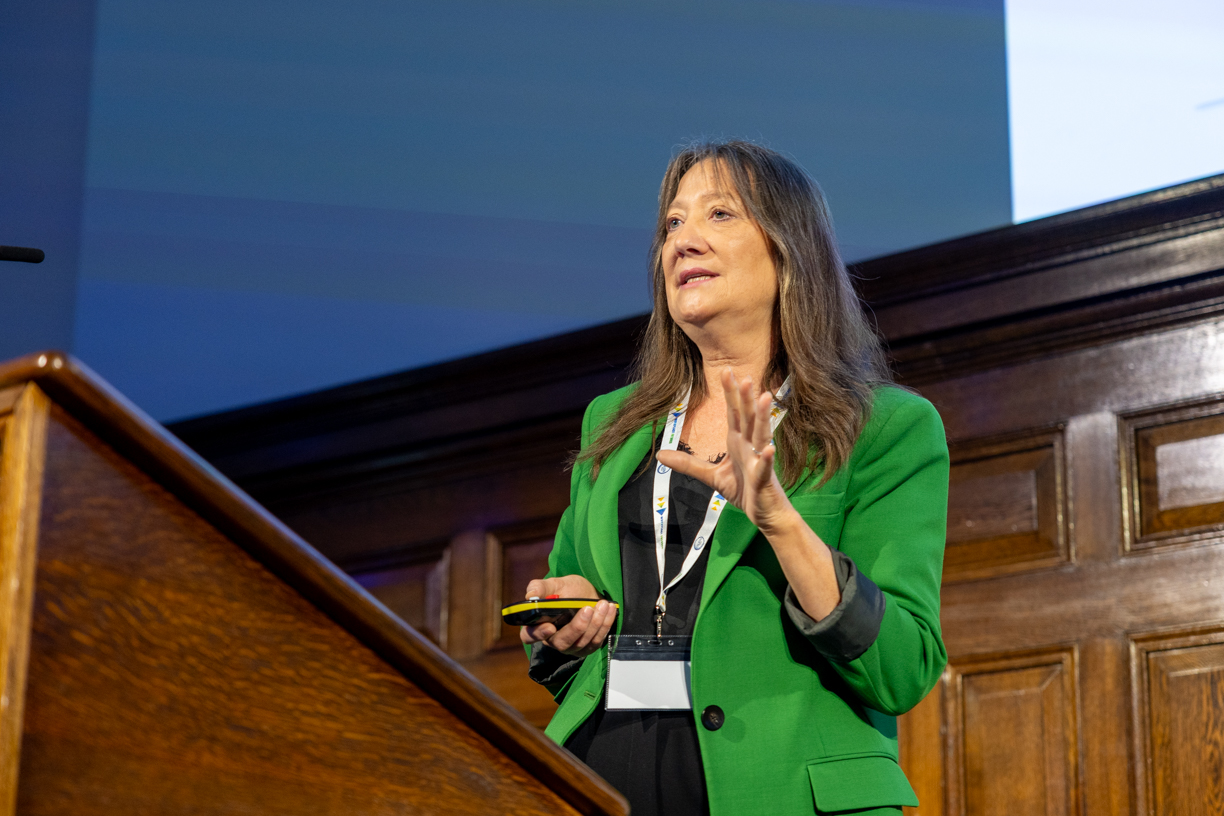
Author: Sarah Hodge, Global Workplace Experience Director, London Stock Exchange Group

How did we get here?  That’s a huge question.

If we look purely at the size of the FM market from the 1970s when the term ‘facilities management’ was first established in common business language use to where we are now, it paints an extraordinary picture. Facilities management has been over that time one of the fastest growing professions and important markets in terms of GDP, and is predicted to grow further by 3-4% into the next decade.

But how did this happen?  

I found this excerpt from a ‘Dear Guru’ column by Martin Pickard in FMX magazine from May 2007:

Origin of the Species

It’s an interesting history that nobody seems to have fully documented. The practice of facilities management has, of course, been around since our ancestors first took shelter in a cave. Someone had to take responsibility for the care and upkeep of the place. Over the centuries, the function appears in many forms - the Roman Praefectus Castrorum, the Lord Chamberlain of the Royal Household, the traditional English butler - each one, a professional manager in charge of buildings and services. There are even references in mid19th Century public records to a Department of Facilities responsible for the newly created State of Wisconsin.

The first use of the actual phrase ‘facilities management’ is generally credited to Ross Perot in the ‘sixties when describing his new business Electronic Data Systems. EDS is regarded by many as the first genuine outsourced service provider, and ‘facilities management’ became a generic term for third-party management of IT services. Mostly a US thing, but I certainly remember the IT guys from BT talking about FM in those terms during the 1970s.

So, let’s bring the story to life.

It is amazing to reflect on where we are, what has been achieved since the 1970s when facilities management emerged as a discipline. I couldn’t possibly include everything in a 20-minute presentation. I spent hours in lovely meetings, reminiscing, chatting with key people who shaped the industry - the evangelists, the advocates and the pioneers!  There was much laughter and a few tears along the way, for those no longer with us. It was a lovely stroll down memory lane. However, fitting it into 20 minutes felt like a mad dash through the decades.

The material gathered for this paper doesn’t just fill pages; it pulses with the kind of insight and energy that could power an entire day’s conference. That’s because the story of facilities management is a story of transformation, purpose and unstoppable progress. FM hasn’t merely evolved; it has ignited - growing from the behind‑the‑scenes function to a structured, standards‑driven discipline powered by innovation, adaptability and an ever‑growing commitment to excellence and its purpose.

We are not just tracing history; we are spotlighting a profession that leads, adapts and inspires.  We celebrate more than processes and systems; we celebrate people, progress and the powerful shift that has elevated FM into the forward‑thinking strategic discipline that it is today.

From the professionalisation of our practice to the dynamic service delivery ecosystem that supports it, our journey reflects resilience, creativity and an unwavering focus on solving complex business problems and enabling organisations and their people to thrive.

And of course there are some long-running debates that persist. I will highlight these through the paper, for consideration when looking to the future.

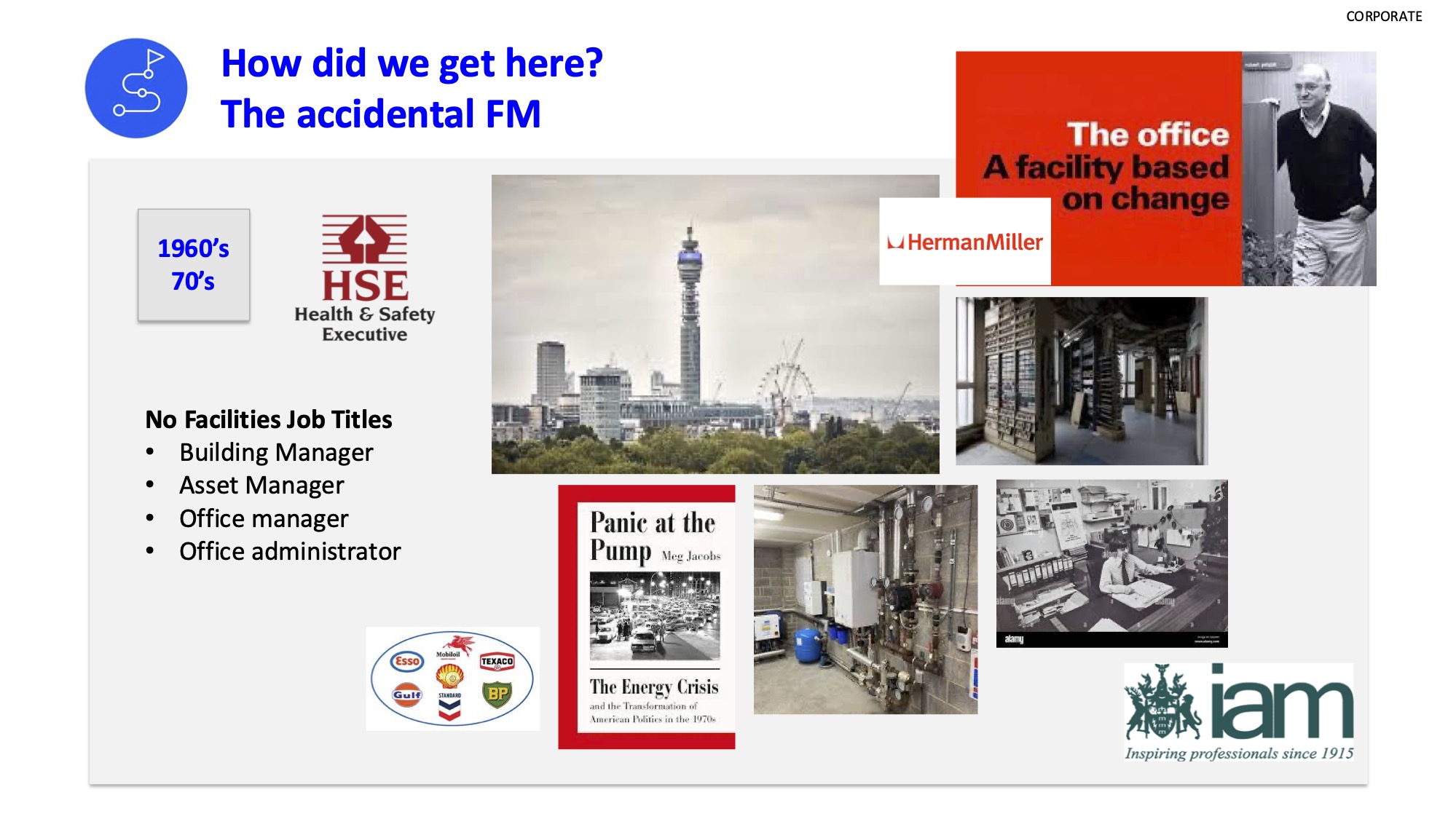
1970s: The Accidental FM

The 1970s may have been a decade when facilities management didn’t exist as a job title, but the work absolutely did. It was carried out by the fixers, the solvers, the people keeping organisations running without ever being recognised for it. They sat in admin, office services, engineering, building management. Each doing pieces of what would later become a global profession.

To understand the ‘70s, let’s hear from some of the key FM people who lived it.

Marilyn Standley, who would later become the first chair of BIFM, dreamed of running operations as a station manager for British Rail. But in the ‘70s, women weren’t even allowed to apply. So, she was pushed into personnel instead, and that’s where she discovered the people doing what we now call FM: managing moves, the post rooms and the day‑to‑day running of office life.

She fell in love with this work.  FM found her by accident - just like it did for so many.

Debatably this is still the case – and something that we need to solve? Interestingly, this is not the case in many other countries globally. What needs to be done to rectify this in the UK and for FM to become a career of choice, not chance?

Then Jane Wiggins. Jane was already a member of IAM (the Institute of Administrative Management). The administration sector already had well-established qualifications and structured pathways that had been in place for nearly 100 years. These people were carrying out the administrative processes of running buildings, but nobody called it FM. Jane became a powerhouse in shaping early FM professionalisation. She used these established frameworks to create the foundations of FM training and qualifications that were to become ultimately the IWFM qualification and competency framework.

Jane later published the go-to book for facilities managers, the Facilities Managers Desk Reference, which is still in publication today.

She went on to head up BA’s iconic HQ, the Waterside building near Heathrow, designed as a ‘city within a city’ around streets and cafes, facilitating socialising intentionally to drive collaboration and enable people to do their best work.

Jane represented the shift from ‘just get it done’ to ‘let’s define how it should be done and teach it’.

And of course, ‘the guru’ - Martin Pickard, a guru long before he added the FM to the title.  Martin came on the scene in the ‘70s working as an accommodation officer for the Post Office and then building manager for BT. He remembers the BT leadership formally writing to the team, stating that There is and never will be a place for facilities management in BT or the UK. It’s a made‑up American thing.”

Meanwhile, Martin and his colleagues were already doing it - keeping complex telecoms systems and buildings such as the BT Tower running around the clock and adapting workspace to accommodate newly launched systems furniture.

Martin’s story shows just how misunderstood the profession was, right up until organisations realised they couldn’t function without it.

The 1970s brought bigger, more complex buildings, the first workplace technologies, economic pressure with a recession, the energy crisis, inflation and the three‑day week. Large in‑house teams ran everything. Driven by economic efficiencies, organisations started questioning what ‘core’ meant in their business. This triggered the first wave of single-service outsourcing: cleaning, catering, office services.

Early CAFM systems emerged from primitive mainframes and punch cards, mainly for energy monitoring. It was the quiet beginning of data-driven FM even then!

Professional communities existed, and some new ones emerged and began to form alliances, one example being the IOM (the Institute of Office Management). The Office of the Year awards were launched, celebrating great office design and how this supports the people working in those environments.

Internationally, specifically the US, furniture company Herman Miller held a conference in 1979 in Michigan, where the term ‘facilities management’ came to life. It was the focus of the discussion for the conference and looked forward to what it meant for the future of work. It inspired the founding of the Herman Miller FM research institute and what was to become IFMA (the International Facility Management Association) in 1980.

So, by the end of the decade, even though no one used the title, every ingredient of FM was already there. Complex workplaces, early technology, economic pressure, outsourcing and passionate pioneers like Marilyn, Jane and Martin building a profession from the ground up.

The 1970s didn’t give FM its name, but it gave us the momentum that made FM unstoppable.

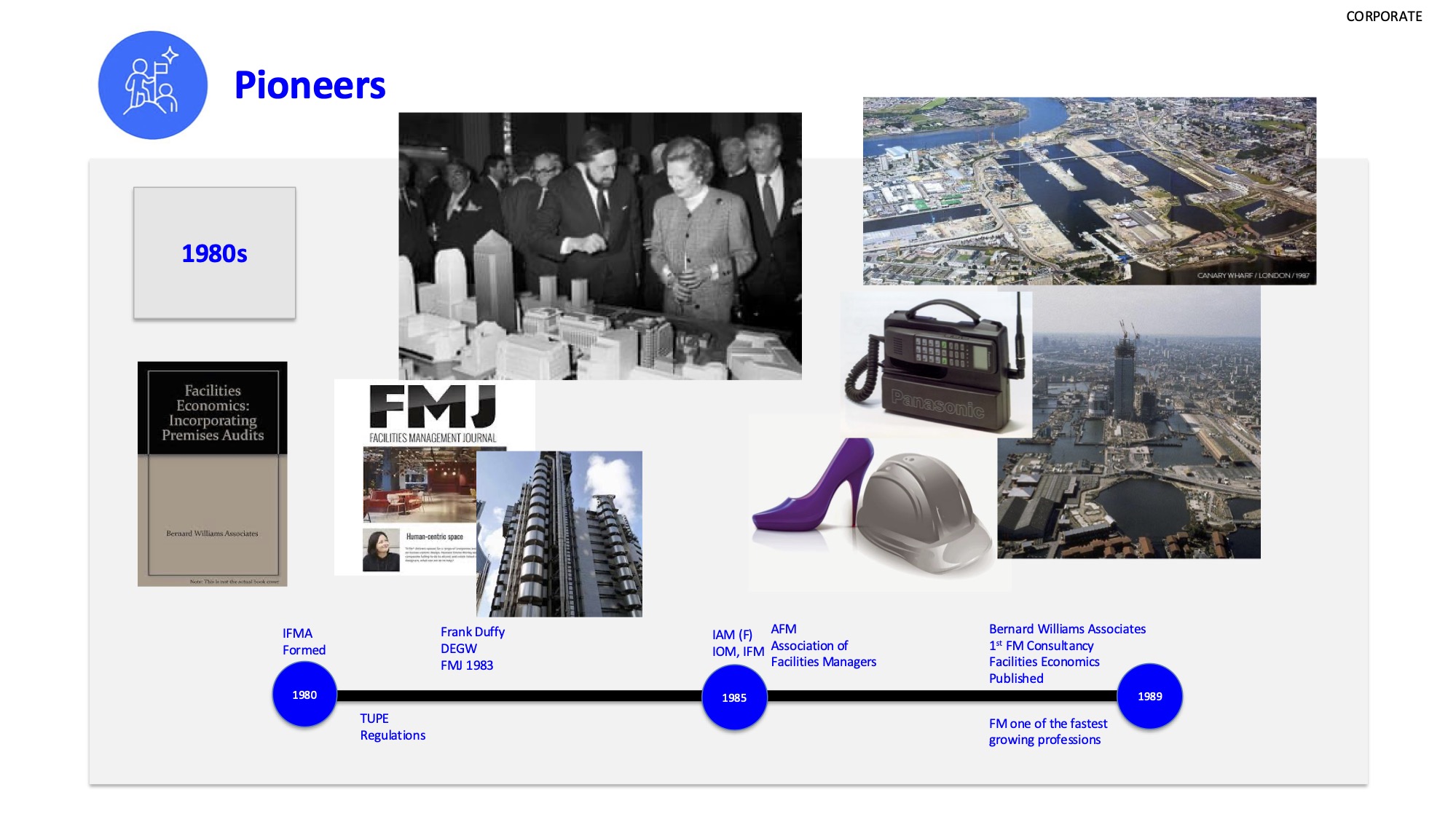
The 1980s: Pioneers

At this point, facilities management was becoming ‘a thing’ - if the ‘70s gave FM its roots, the ‘80s gave it a name and an identity.

This opens the door to another debated topic: identity vs purpose. Does FM have a strong enough Identity, and is that critical to its success?  In the debate between facilities management identity and purpose, purpose is generally considered more critical for long-term strategic success, while identity is foundational for professional and organisational recognition.

The 1980s started with the newly formed IFMA - which had recently renamed itself from the original NFMA to reflect the international reach of the new facilities management ‘thing’.  

Frank Duffy of architects DEGW was designing buildings with activities and organisational culture at their heart, buildings to enable people to thrive. He was for the first time talking about how accommodation would be run and managed in operational use and through time. Frank and DEGW are often cited as establishing the use of the term facilities management in common business language in the UK. Frank, who died in late February 2026, is widely considered the original pioneer of FM. He certainly inspired me and many others, and will be greatly missed.

DEGW went to launch the Facilities Management Journal, a title still published today.

Martin Pickard remembers being excited when he read FMJ. One article argued: “It’s time the occupiers had a voice”, championing a clear role for the building manager in the design and operation of the workplace. Duffy was there reporting on a speech by Sir Monty Finiston at the Manchester Society of Architects, referring to this role as “what I believe the Americans call facilities management”.

Stan Mitchel was another leading light in those early days. Stan has been a constant evangelist for FM and would become chair of BIFM, as well as making many other significant contributions to the profession and the progression of FM to where we are today.

Stan had left the merchant navy.  Recalling those days, he says: On board ship, you had to solve all the problems and fix everything.” He adds that all he had was “common sense and logic” as the route to finding solutions - key attributes of FM, of course. Later, Stan landed a job with Wang Computers, helping to build and run their new factory in the then nicknamed ‘Silicon Glen’ in Scotland.

He remembers thinking “there must be a better way.  Other people must be doing this – how can I connected and network beyond this location?”

At the same time, others such as Derrick Paxman, Derrick Butcher, Marilyn Standley, Jane Wiggins, Martin Pickard, Geoff Gidley, Graham Brisco and Barry Varcoe had also read Duffy’s article and were starting to connect, network and discuss facilities management. These connections would eventually come together to form the AFM (the Association of Facilities Management) in 1986.

The purpose of the AFM was to:

  • Connect likeminded people
  • Develop a unified identity and brand for FM
  • Give a voice, credibility and standards.

AFM established an early education committee which brought forward the established IAM framework.  On that basis, AFM started to build the frameworks for FM education and professional standards. Martin recalls them knocking on university doors to establish a facilities management degree, but to no avail at the time.

The ‘80s saw a significant boom in the UK in construction of corporate real estate, with marble and glass filled buildings and lavishly expensive interiors with designer furniture reflecting the wider Thatcherite boom and the ‘work hard, play hard’ culture of the time. 

Canary Wharf was the largest development in Europe in those days. I started as a hard service installation project manager, working for Olympia and York who were leading the construction.

It was a fascinating time being on-site as the only woman on the largest site in Europe with 4000+ construction workers. Interestingly, given the trend, today this would only have risen to 440 females and at that rate it would take 200 years to get parity. Gender parity in FM senior management is not expected to be reached until 2053. While progress has been made, there remains a significant gap, with females making up 36% of the workforce in FM.  At senior leadership level, this figure is reduced to estimate 32%.

I learned a huge amount about buildings and running them in occupation at Canary Wharf. The operations and use of the buildings had been considered throughout the design process, which was unusual for the time. We set up Canary Wharf Limited to manage the estate, one of the first total facilities management companies. Keith Glenester and John Delucy headed up the operations - an early example of unified, strategic, focused management of buildings and service delivery long before integrated FM appeared.

In contrast to the hedonistic money-fuelled days of the early and mid1980s, the late 1980s saw the financial crash and recession, triggering organisations to focus on cost and efficiency.

Bernard Williams Associates, the first FM consultancy, published Facilities Economics which documented cost of service and established the business language of benchmarking and value. BWA worked with organisations to ensure cost of delivery was right-sized, and they continue to do so today.

We also saw a shift away from in-house and single-service delivery, as bundled services started to emerge with the service delivery market responding to client demand for efficiency - as FM began to focus on cost of delivery and value.

M&A starts to happen in the market about now in response to finding more joined-up delivery solutions - and this trend certainly continues today.

So FM was a now definitely ‘a thing’: we had a name, networks, a voice and a purpose. The FM profession had started to be built not by policy or accident, but because a group of people - the pioneers - saw a problem and set about fixing it.

The pioneers in the ‘80s didn’t just manage facilities; they started to build a profession.

1990s: Taking off

In the 1990s, FM is cited as the fastest growing profession. FM shifted from a fragmented set of responsibilities toward a structured, recognised professional discipline. This was driven by workplace change, technology and more complex business issues, and the need for a more strategic approach to managing buildings and services.

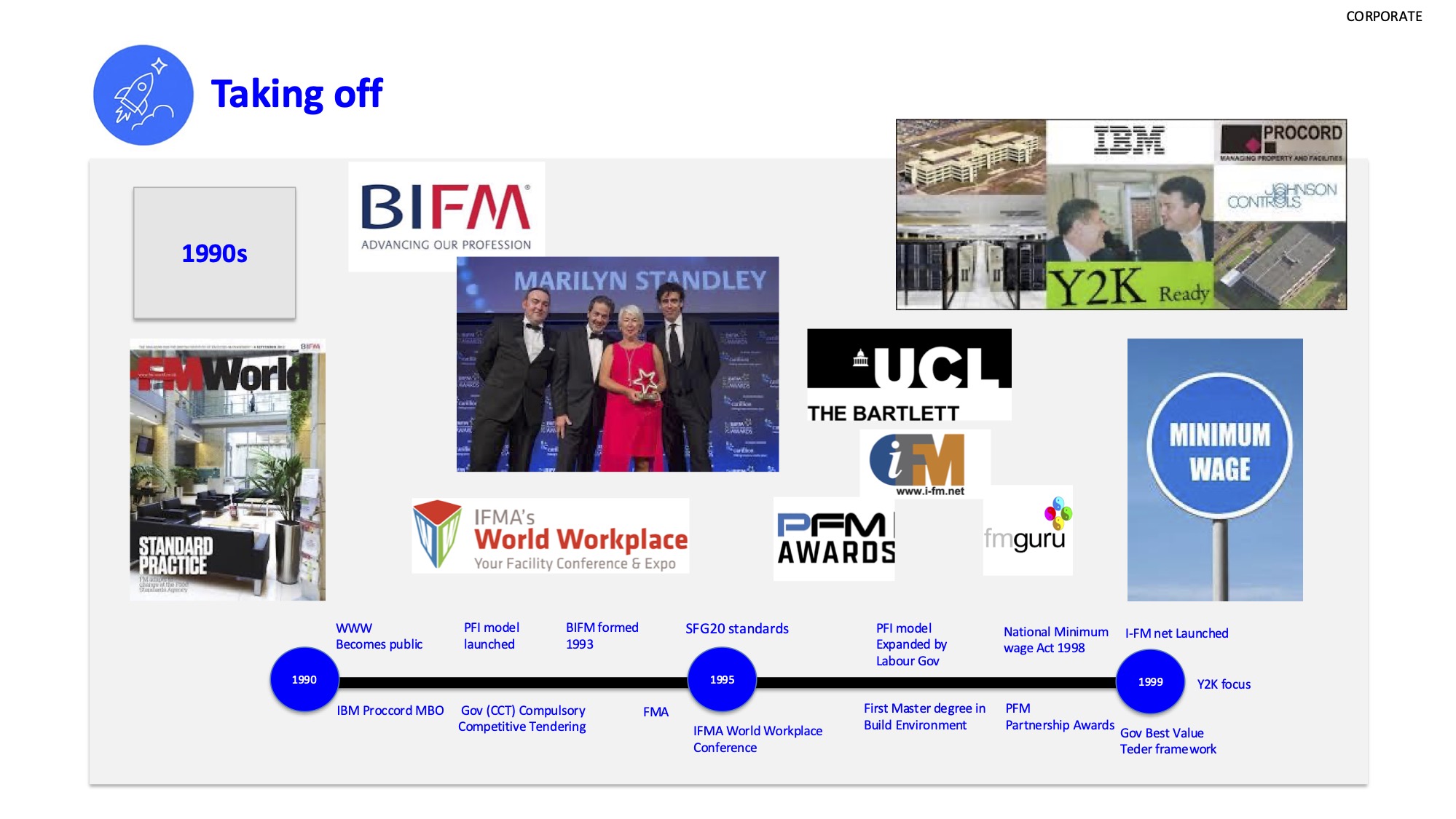
The decade saw the first real generation of outsourcing. A Key feature was a management buyout at IBM, created Procord (which later to evolved into Johnson Controls).  This was a group of real facilities powerhouses who drove FM as a strategic discipline, pioneering delivery of new service models and ultimately transforming many individual service providers into comprehensive management operations. Th drive was led by John Jack and David Burnett, along with others such as outsourcing pioneer Oliver Jones. (Incidentally, Frank Duffy had worked with this group at IBM.)

This became a defining moment. These ‘godfathers of outsourcing’ reshaped the UK market and showed how FM could be delivered differently. This was the start of the early TFM models and growing contracts in the private sector.

At the same time, the Conservative government launched the Private Finance Initiative (PFI), starting in 1992, primarily to fund public infrastructure such as hospitals, schools and roads. These were designed to bypass public borrowing constraints and looked to improve efficiency and leverage expertise from the private sector, transfer risk and bring a structured approach to whole-life cost and long-term maintenance and management of assets.  

Figures such as Oliver Jones and John Jack were deeply involved in shaping these models. Compulsory Competitive Tendering quickly followed, cementing outsourcing as the primary method for delivering public sector services. New service companies emerged to meet the moment. Trailblazer organisations such as Charter Services, led by Lucy Jeynes and Mike Cant, formed an early joint venture with outsourcing company Simmonds FM to bid for the first large‑scale outsourced contracts.

Th PFI model was later expanded by the Labour government and would grow and evolve over years.  Indeed, it is still evolving today with new schemes being launched in 2026. FM consultant Mark Griffiths has been involved in PFIs for some years. He says: “They get bad press, but there have been some real success stories from those early deals.” At this point, it is interesting to ask if the industry as a whole missed a trick in learning from the model of whole-life costs and cost in use?  Have those concepts been embedded throughout the industry?

The ‘90s also marked a major milestone - the formation of BIFM, the British Institute of Facilities Management. This saw the two boards of precursor organisations IFM and AFM come together, uniting pioneers including Derrick Butcher, Geoff Giddily, John Crawshaw, Martin Pickard, Graham Biscoe and Marilyn Standly, who became the first BIFM chair. This was the moment the profession gained identity, structure and a unified voice.

When the BIFM (now IWFM) was created, a long-running debate began, and it’s still going on today. The question is, is facilities management a profession, a management discipline, or is it a service delivery industry?

Many people, including Stan Mitchell, believe strongly that FM is a management discipline, not just the delivery of cleaning, maintenance, security, catering and other services.

This leads to another long-running debate: chartership.  It also leaves open the question - If IWFM represents the FM profession, who represents the FM industry?

Achieving Chartered status would elevate the profession’s status, provide a ‘trusted voice’ and create a distinct professional identity on a par with other established professions.  The IWFM remains committed to building its case to become a Chartered body, describing the aspiration as “fundamentally important” to the institute: “IWFM always have Chartership at the forefront of our mind, and when we developed the 2023-25 strategy it was with Chartership absolutely front and centre.”

This is still to be realised.

There was also in the ‘90s an active trade body called the FMA (Facilities Management Association), but it has disappeared. So, now people wonder whether the whole sector is properly represented at all.

During the late 1990s the big service companies such as JLL, CBRE and Sodexo grew massively. These sorts of service providers employ most of the UK’s FM workforce, and they now shape:

  • Careers and career pathways
  • Training and qualifications
  • Research
  • Innovation
  • Thought leadership.

However, these companies are service delivery providers, not organisations of facilities manager necessarily carrying out the management discipline. This adds even more fuel to the debate.

Also late in the 1990s major corporates such as Shell, BP and the BBC began recognising the workplace as a driver of culture, talent attraction and retention. FM started to embrace service culture, customer experience and brand expression. The impact of frontline teams, skills development and labour shortages became central themes and highlighted how much the industry still underestimated the value of its people.

Education also accelerated. Training courses expanded, and UCL launched the first FM Master’s degree, led by two former Procord team members. (There is some debate about this as a ‘first’ as some have pointed out that Masters degrees did exist earlier, for example under the surveying label.)

I was on the first cohort at UCL. My dissertation focused on people, to some extent in response to discussion at the time.  This was something Oliver Jones has always been passionate about: “Do we have leaders in FM or good operators/managers who can’t lead and won’t be able to lead the sector forward with strength to meet its growth demand? Where are our leaders going to come from?”  We still have this challenge today, of course.

My second topic was a mission that has always been close to my heart and always will be. This explored the impact of our front-line teams on the bottom-line of the organisation. This is not just about customer service, upskilling and enabling our people to progress and thrive in FM, but about labour shortages, talent shortages and again a missed opportunity for the industry - in valuing people so they are proud and want to build a career in, and become champions for, FM whatever their background.

The origins of educational structures in FM were multiple. Simon Ball offers some insight on the impact of the Centre for Facilities Management.  CFM launched in 1992 and was led by Keith Alexander. In the mid-1990s, you could do an MSc in FM via the CFM. Was this the first? They wrote and published many papers and books, organised events and undertook research projects. Working with many of the early influencers, Simon created one of the first FM websites for the CFM, which led him to meet with David Emanuel, contributing to David’s launch of i-FM. CFM was also an active member of EuroFM, which connects national associations, organisations and universities to advance FM research. Simon served as the secretariat, and Keith was acknowledged as one of the founders of FM as a profession from an academic point of view.

The profession’s structure and education resources were beginning to build. But what about the standards - how did the development of standards start and why?

Stan Mitchell shared a fabulous story. He went to a conference in Madrid organised by a group called The Real Estate Fraternity.  They were trying to claim facilities management as their own at the time. There was much debate then about ‘the convergence of property and corporate real estate and FM’.

Stan was the only FM in the room at this event - all the other delegates were CRE professionals. One speaker, a real estate director, stated that FM was just a subset of property. But Stan replied: No. Property is a subset of facilities management.” As the debate continued, the first speaker declared: “You will never be taken seriously as a profession until you have certified qualifications and auditable standards - and you don’t.”

Stan’s personal mission became to prove that speaker wrong. This was the start of his epic dedication to developing FM standards – first, European standards and then ISO. Stan became chair of the BSI FM committee and later chair of the FM ISO committee - years of dedication to prove a point!

Knowledge‑sharing also found a new platform with the launch of FM World, the forerunner to today’s Facilitate magazine, championing the profession through journalism - reporting on the key issues and people in the industry and sharing the news and stories that bring FM to life.

By the end of the decade, we had laid the foundations for outsourcing, professionalism and an academic grounding.  This was the decade in which FM found its position and began shaping the profession that we know today, with an identity and a voice.

FM had shifted from disparate service delivery to business-critical management. FM was no longer about ‘running things’ but about enabling organisations to function. It was part of the strategic conversation. In essence, the ‘90s didn’t just grow FM - it launched it.

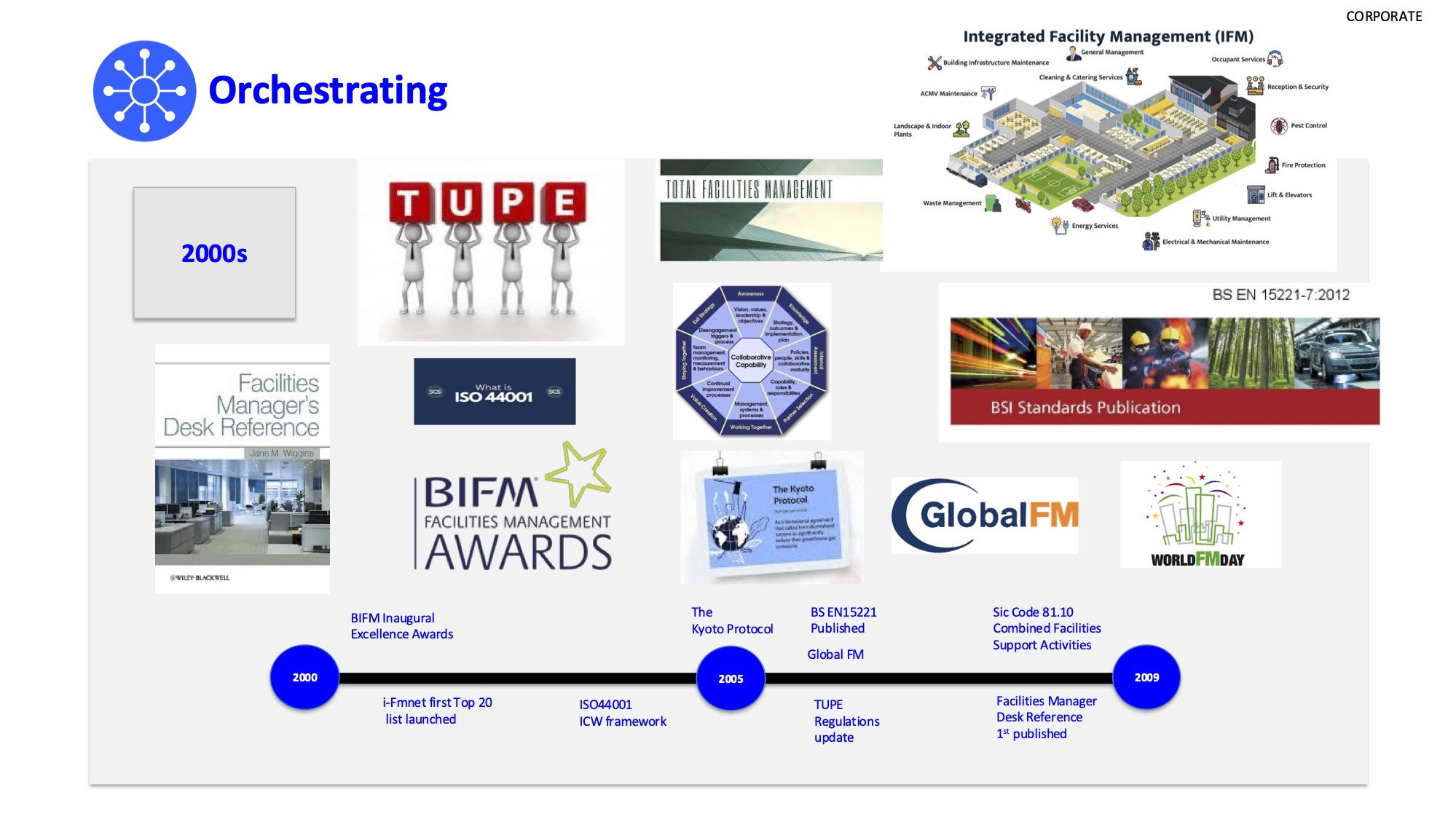
The 2000’s: Orchestrating

At this point, we see the facilities management sector move from operational delivery into a more coordinated, integrated model. This decade is best understood as the period where FM became intentional, global and strategically aligned.

During this period, FM providers and clients shifted away from managing individual services separately.  Integrated FM (IFM) and Total FM (TFM) models became more common, a move from simply delivering tasks to orchestrating how services connected to each other to drive organisational outcomes.

Outsourcing also became more strategic. Agreements focused increasingly on solving problems collaboratively and generating combined value rather than purchasing standalone services.

In addition, global contracts started to emerge, driven by multinational organisations.

In 2004, the Institute for Collaborative Working was formed, and in 2007 the ISO 44001 standard for Collaborative Business Relationship Management was launched. This had been developed to help organisations formalise how to drive more value together, rather than apart!

Globally, Steve Gladwin and colleagues in Australia were observing similar evolution in the FM sector. Construction firms were beginning to add ‘FM’ after their names as service integration and diversity increased. Steve was a member of the FMAA (Facilities Management Association Australia), and members visited the UK to learn from what they considered a more mature market, forming strong international links that supported FM’s global development.

There was still a common and universal confusion over FM’s identity, though. A perfect example is this: Steve was then working at Haydens FM in Australia. They regularly received demo tapes from bands and artists who assumed the organisation was a radio station. Even in the 2000s, FM was still clarifying its brand.

Steve frequently connected with UK colleagues, attending BIFM conferences and collaborating with BIFM members to learn and share from each other.  He felt the UK was a more advanced sector. However, was this the case? The FMAA were outward thinking and looking, not just talking to the local FM fraternity. They lobbied government in Australia with a facilities management action plan. This was well advanced to anything happening elsewhere. This leads me to recall Martin Pickard’s comment where he expressed some regret and reflected on whether we all spent too much time and effort talking to ourselves and debating internally.  Should we have been more focused and placed our efforts outwardly to government and the wider business community to get the FM mantra and messages out there into the world?

The early 2000s saw continued growth in professionalisation. BIFM training matured, and in 2001 the launch of the first BIFM Awards helped showcase, celebrate and recognise excellence across the sector.

In addition, a global collaboration had emerged from earlier cooperation between BIFM, IFMA and FMAA. A tri‑party excellence agreement that helped connect FM communities across the UK, US and Australia, saw the formation of Global FM and led to the launch of World FM Day, which continues today. Steve is very proud of his role as a driving force behind Global FM and a former chair. Stan Mitchell was also chair of Global FM.

The decade also saw the realisation of Stan’s campaign to prove his point as BSI EN Standards were launched, further strengthening FM’s credibility and influence. These were later to evolve from a European standard into the ISO international standard of today.

Talking to Stan provides great insight into the contribution and impact made by the early volunteers and pioneers who were dedicated to advancing the profession of FM. Stan shared that 50% of his working lifetime has been dedicated voluntarily to FM chairing organisations, Standards committees and advancing knowledge.  This kind of dedication and commitment has had a profound impact on facilities management.

Throughout the decade, FM and corporate real estate functions began to merge. Major firms such as CBRE and JLL moved decisively into FM service delivery, creating the global integrated providers that dominate a large part of the market today. This convergence blurred lines between property management, real estate strategy and FM delivery, forming the multidisciplinary landscape familiar to us now.

People and experience also stepped forward.  The 2000s marked a shift from building‑first thinking to people‑first thinking. The question guiding FM changed from ‘what assets do we manage?’ to ‘who are we enabling?’.

The focus extended not only to building occupants but also to the workers who worked within FM supply chains. The sector increasingly understood FM as a value‑creating function rather than a cost‑driven one. Although convincing clients of this is still a challenge!

Sustainability became mainstream and embedded in our thinking following the Kyoto Protocol and was to dominate from that point forward.

Technology began embedding itself more visibly into FM processes. Organisations adopted early digital platforms for contract management and service alignment. Interest in sustainability and energy management increased, and FM started using data to shape decisions - an early form of today’s digital FM.

The outsourcing market grew steadily at around 4–5% per year. This growth was matched by consolidation; M&A activity was commonplace in the market as service delivery companies shifted to meet demand.

By the end of the 2000s, FM had moved well beyond basic service delivery. It had become Intentional, coordinated and globally connected.

As we looked forward to the coming decade, FM was coming of age, growing up. The 2000s was the decade that we moved to service orchestration and full professionalisation, underpinned by standards, formal qualifications and clearer definitions of what excellence in FM looks like.  FM was becoming intentionally integrated and strategically aligned to business outcomes. Post-recession environments drove a focus on efficiency, risk management and long-term strategic partnerships. IFM was evolving beyond TFM into flexible, pillar-based bundles with outcome-based contracts.

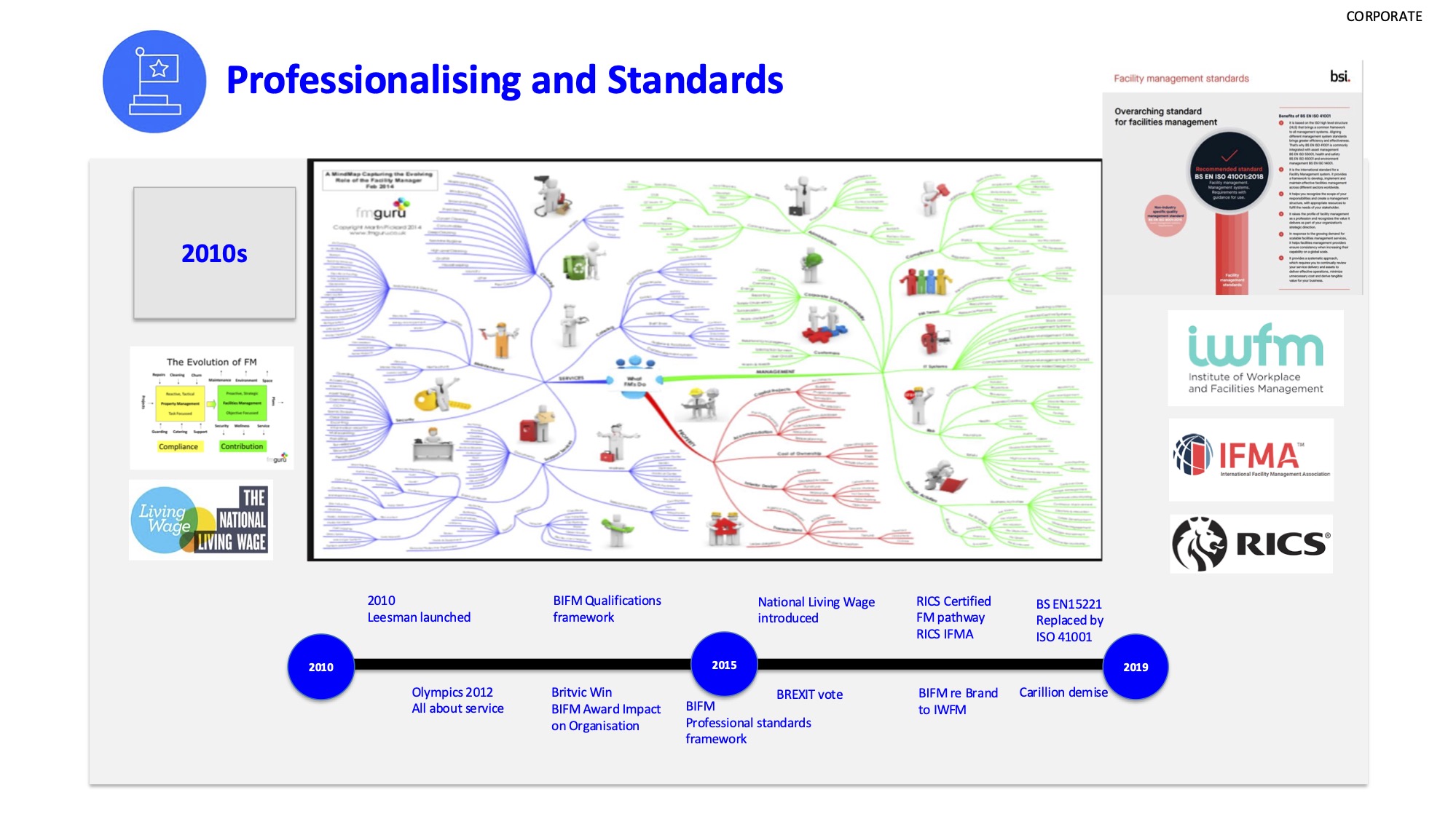
The 2010s, Professionalising and Standards

In the 2010s, organisations realised FM wasn’t just delivering services — FM was delivering business value.

It was a busy decade. Following the introduction of the SIC Code 81.10 in 2008, by 2010 the FM market is valued at £85bn in the UK - driven by increasing demand for complex technical services.  And the trend of M&A activity continued.

The Leesman Index, founded in 2010 by Tim Oldman, would become the world's largest independent database of employee workplace experience insights, featuring data from over 1.35 million employees across 91 countries. It was developed to measure how the design and management of the workplace impact employee performance and is used by many organisations as a global benchmark.

And then, of course, cam the London Olympics in 2012.  The significance of this in the story of FM is the stance taken by Mayor Ken Livingstone, who led the bid and the effort to get the Olympic sites, infrastructure and the whole of London ready to deliver the best Games ever. Livingstone famously said when asked what he was most worried about was that he had no doubt that we would provide the infrastructure, deliver the buildings and mobilise the services on time – but our biggest challenge was to get everyone to smile everywhere across London.  Thus the ‘games maker programme’ was born. This had a profound impact on FM and its drive to become customer-focused ‘how do we get our security guards and engineers to understand and deliver great customer service?’   In other words, a shift in focus from not just what we deliver, but how we deliver it.

The same year Britvic (led by me as programme director) won the IWFM Impact on organisation award for their new headquarters building.  Significantly, this was not an award for the building and its design, although that was award-winning too; but for the impact it had on the strategic direction, culture, organisational redesign and change to drive collaboration across the organisation.  The award recognised how the building enabled that. The project was also recognised by the City and regulators which reflected in the company’s share price, noting the impact it had on the way the company responded to risk and organisational resilience and transforming the whole operating model.

Workplace had become a strategic asset shaping culture, performance and collaboration, and wholly aligned to strategic outcomes.

In parallel we see a rising awareness of wellbeing.  The term appears widely only after 2013. Martin Reed in our chat about the history of FM reminded me that ‘wellbeing’ appeared for the first time in corporate language at about this date - it really doesn’t seem that long ago, does it? Now it’s a critical outcome and firmly embedded in our FM business-as-usual language.

Martin Pickard developed his well-known mind map, mapping what FMs do - again voluntarily dedicating time and sharing knowledge for the industry and further advancing the profession.  This is still used in training in FM today.  

The importance and impact of the workplace impact was brought to the fore by the Stoddart Review in 2016, The Workplace Advantage. This review highlighted that workplace is a critical lever for increasing UK productivity. It argues for shifting focus from cost-cutting (density) to performance (employee experience).

The second half of the 2010s also saw professional frameworks maturing, with the BIFM (IWFM) qualifications framework and clearer definitions of FM competencies set out in the Professional Standards Framework.

In addition, RICS launched its certified FM professional pathway to membership.

And certainly ISO 41000 was a major milestone, giving FM for the first time in its history an international language. 

In 2018, the BIFM rebranded and became IWFM, signalling a shift from pure facilities to the broader workplace experience.

This came against an expanding legislative landscape for FM: governance, regulations, ethics and sustainability are all key themes of the late 2010s.

Then also in 2018 came the collapse of Carillion, one of the largest service delivery providers in the sector. A real seismic moment for the industry, it exposed the dangers of race‑to‑the‑bottom procurement, unsustainable debt, risky contracting and governance failures. This event forced the industry to redefine what value really means.  And more immediately, of course, there was a severe impact on thousands of employees. 

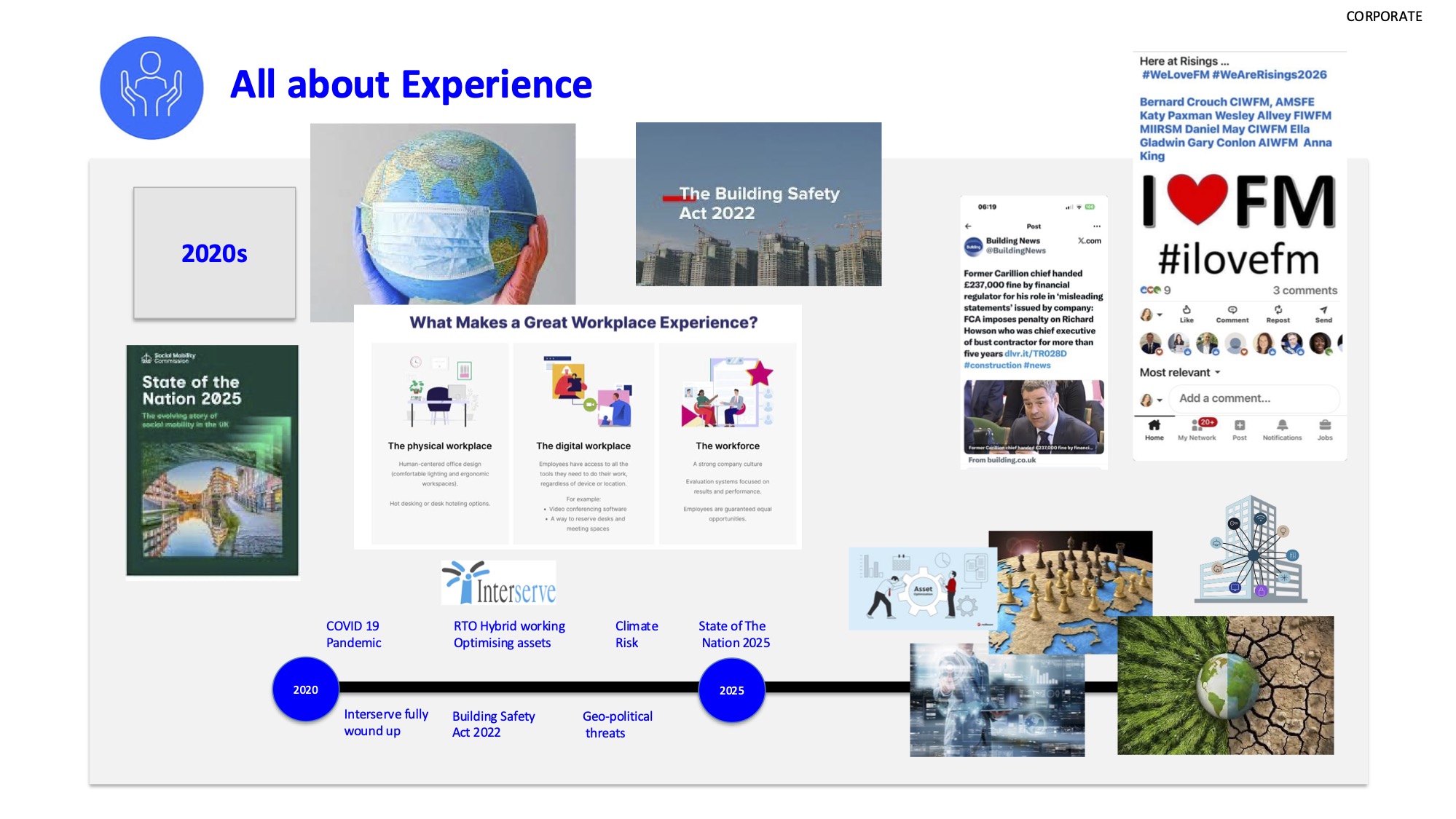
On another challenging note, amid the progress of the sector and growth of the 2010s, the Social Mobility and Child Poverty Commission's first annual State of the Nation report (2013) reminded us of the tough truth and highlighted deep-seated inequalities, noting that prospects for the disadvantaged were not improving.  The report emphasised the need for new policy and wholesale change in sectors and fair access to professions. The UK was far behind many western European jurisdictions and had a long way to go, it said. This remains a missed, huge opportunity for FM to significantly contribute to GDP by improving social mobility. The 2025 updated report shows little progress on this. Too many people in FM are still stuck in low‑pay, low‑progression trap.

The 2010s highlighted FM’s responsibility, and the opportunity, to unlock talent and impact social mobility.  There has been some progress, but much more could be done.

By the end of the decade, FM had a professional backbone: an identity, global standards, qualifications frameworks and career pathways.  There was recognition of workplace as a strategic asset. We were no longer the hidden profession.

The decade marked a shift from operational FM to intentional business‑aligned FM. Organisations weren’t looking for service delivery they wanted strategic value, cultural alignment and outcomes that supported their business strategy.

FM stopped being the back-room engine and became an indispensable strategic partner at the heart of organisational success.

2020s: All about Experience

As we entered the 2020s, none of us could have predicted just how dramatically the world and the world of work was about to change

The 2020s opened with probably the single biggest shock the world has faced in living memory: the global pandemic.  Buildings emptied almost overnight.  FM teams were thrust into crisis mode, ensuring safety, maintaining essential assets and rethinking operations in real-time. This wasn’t a temporary deviation. It was the start of a new era.

‘Workplace experience’ has become a competitive advantage.  As the world reopened, work didn’t go ‘back’ — it moved forward.  Hybrid work cemented itself as a long-term reality.  Organisations worldwide are now operating with persistent hybrid schedules, fluctuating occupancy patterns and a renewed expectation for workplaces to be ‘worth the commute’.

FM became the architect of purposeful, high-value, in-office experiences. This is about the physical, digital and cultural experience brought together in a holistic, seamless way - enabling people to have their best day and do their best work.

Employee expectations soared, and FM rose to meet them.  FM isn’t just maintaining space; we are now shaping holistic experience across wellbeing, engagement, culture, collaboration and performance

After experiencing global disruption, organisations recognised the need for stronger resilience. Risk has become part of everyday activity. The message of the decade is that resilience isn’t optional - it’s foundational.

Supply chain fragility, inflation, climate events and geopolitical pressures have become everyday realities for business and for FM. Climate impact is being felt daily; geo-political threats are increasingly mainstream.

This all emphasises the criticality of a shift to integrated risk management and enterprise resilience as top strategic priorities.

The 2020s brought something profound: recognition.  CoreNet Global noted that “FM demonstrated extraordinary agility during the pandemic - often being the only professionals on-site, protecting assets, ensuring safety and sustaining operations during crisis. This elevated the profession’s profile and brought new respect, influence and strategic visibility”.

FM stepped out of the background and into the spotlight.  This is a profession that proved its value. This was the decade in which FM didn’t just support the organisation. It kept the organisation standing. It helped it adapt. It helped it thrive.

The 2020s proved, without question, that FM is a strategic powerhouse.

So, what for the rest of the decade? What are my top priorities and focus areas at LSEG?  What are the hot topics for the global roundtable that I sit on? 

Many of these topics are on the agenda at Workplace Futures.

My focus areas with a 130-building global portfolio, include:

  • Optimisation of our assets; rationalising and consolidation of our footprint
  • Every day geo-political threats; Ukraine, Middle East, India and Pakistan
  • Climate impact is now; it’s not in the future! Yes, we have net zero and CSRD reporting targets. But what are our strategies to deal with impact to business and our people now? Climate resilience and action need to be considered daily as BAU.
  • Energy loading, restrictions and interruptions in countries.
  • Technology, data and AI – realisation of real operation benefit
  • Dynamic flexible and on-demand servicing; how we flex and scale operations globally to realise benefits and optimise experience aligned to our hybrid patterns.


It really is all about the people

Our industry didn’t evolve by accident. It grew because people cared enough to push boundaries, connect dots, challenge norms and drive meaningful change.

People who, yes, had a bit of logic, commonsense and problem-solving skills. But more importantly, people who were outward looking, who hunted down and found connections with likeminded people beyond their locations, who explored solutions to ‘there must be a better way and who had a vision to build a profession. Maybe there was a bit of serendipity along the way, and certainly a lot of fun. We didn’t have a collective identity or a brand, but we did have a profound sense of purpose, passion, dedication and belief in facilities management.

Today, as we think about defining the roadmap of the future, I ask what are you doing about advancing the profession? Do we still have the people today who will dedicate themselves so purposefully? How will the profession keep evolving?  

Facilities management has evolved into a complex strategic discipline integral to organisational success. With workplace, or as I put it ‘the experience of work’, enabling people in the organisations to perform at their best, it’s grown and adapted to external forces, regulation and legislation to solve ever more complex business and global problems.

But we need to remember it shouldn’t just be about the organisations we serve and enabling them and their people to succeed.  It needs also to be about our people - the people who work in FM

The growth predicted in the FM market is about 4%, with labour shortages and margin pressures cited as restraining factors to achieving this growth.

The labour and skill gap is significant, and it is vital that we work together at speed across private and public sectors to address the problem and enable and develop talent from all social economic backgrounds. 

Additionally, we know we have an ageing workforce, with something like 50% of those in FM reaching retirement age in next eight years.

We have a huge pool of untapped talent in and around the sector.  We need to intentionally remove barriers to employment and progression. Enabling anyone from any background to enter and thrive within FM.

So, let’s commit - intentionally, boldly, unapologetically - to removing barriers.
Let’s spot potential where others might overlook it. Talent is everywhere; opportunities are not.  If we do that, together, we won’t just shape the future of facilities management.  We will enable our people to thrive, our organisations to thrive and society to thrive.


Download Presenter Slides

Watch Recorded Presentation
The UK facilities management industry in 2026 – market outlook and growth opportunities

We are seeing an increasingly dynamic transformation of FM markets driven by technology, sustainability, workplace optimisation and user experience.

Author: John Raspin, Partner, Frost & Sullivan

The UK facilities management industry is entering one of the most transformative periods in its history. As the most mature FM market in the world, the UK is often where new service models, technologies and strategies emerge first. What we are seeing today is a fundamental shift in how FM is perceived and delivered.

Historically, FM was largely viewed as a cost-driven outsourcing function focused on maintenance, efficiency and service delivery. That perception is rapidly changing. FM is increasingly recognised as a strategic enabler of organisational performance - supporting sustainability, workplace productivity, employee wellbeing and digital transformation.

What we are seeing today is a fundamental shift in how FM is perceived and delivered.

The scale of the opportunity is significant. The UK spends roughly £75 billion per year on FM, equivalent to just over 2.5% of national GDP. Within that, the outsourced FM sector accounts for more than £35 billion, served by hundreds of providers competing in a mature but steadily growing market. Growth may remain relatively modest at around 3% annually, but the strategic importance of FM is expanding rapidly.


As 2026 gets going, we can say the last decade’s been pretty eventful. There’s been Brexit, Covid-19, post-Covid supply chain disruption, unprecedented cost inflation and economic uncertainty.  There’s been labour market volatility, new working patterns, a stubborn cost of living crisis, a change of government, sustained pressure on public services.  Yet throughout all that, FM spending has continued to outperform the economy and expand above GDP growth.  In fact, since Covid, the FM market has entered a new phase of accelerated growth and transformation.

FM spending has continued to outperform the economy and expand above GDP growth.

Looking ahead, several powerful forces are reshaping the industry.


Artificial intelligence is moving from hype to operational reality. Early use cases such as predictive maintenance and energy optimisation are now being complemented by workplace analytics, intelligent automation and conversational interfaces that allow employees to interact more easily with building services. The result is a shift from reactive service delivery to proactive management of workplace experience.

Closely linked to this is the continued rise of smart buildings and data-driven FM. Significant investment has already been made in IoT sensors, digital twins and building analytics platforms. The next phase is about turning that data into tangible value - improving energy efficiency, optimising workspace utilisation and enabling more intelligent service delivery. FM is becoming a key provider of operational intelligence for the built environment.

At the same time, customer expectations are evolving. Traditional service-level agreements are increasingly being supplemented - or replaced - by outcome-based partnerships that align FM more closely with client priorities. These priorities may include achieving net zero targets, supporting hybrid work models or enhancing employee engagement. Providers that deeply understand the sectors they serve and align closely with client strategy will have a clear advantage.

Another defining trend is the shift toward human-centric workplaces. The post-pandemic workplace has changed expectations dramatically. Organisations are no longer assessing workplaces purely on cost or uptime, but also on how effectively environments support wellbeing, collaboration and productivity. FM providers are therefore playing a more visible role in shaping employee experience through workplace design, environmental quality and service innovation.

FM is becoming a key provider of operational intelligence for the built environment.

Overlaying all of this is the growing urgency of decarbonisation and ESG performance. Buildings account for around 40% of UK carbon emissions, placing FM providers at the centre of efforts to reduce environmental impact. From energy analytics and low-carbon retrofits to sustainable cleaning and waste management, sustainability is becoming embedded across the entire FM service portfolio.

Meanwhile, economic pressures continue to sharpen the focus on efficiency. Inflation, energy costs and labour shortages mean clients are demanding cost savings - but not at the expense of service quality or innovation. Digital tools, automation and robotics are therefore becoming important enablers of productivity.

Finally, the industry itself is evolving rapidly through mergers, acquisitions and private equity investment, which are accelerating consolidation and enabling companies to scale capabilities, invest in technology and expand into adjacent service areas.

Taken together, these forces point to a clear conclusion: FM is no longer just about maintaining buildings. It is increasingly about optimising the environments where people work and organisations operate.

The providers that succeed in this next phase will be those that combine operational excellence with technology, sustainability leadership and a deep understanding of customer needs. In doing so, FM will continue its evolution - from a traditional support service into a strategic partner in organisational performance.


Download Presenter Slides

Watch Recorded Presentation
Power to the people: why facilities management’s competitive edge is capability, not technology

The competitive edge in facilities management will not belong to the organisation with the most advanced technology, but to the one whose people consistently operate at the top of the cognitive stack.

Author: Steve Gladwin, Director, Nodus Solutions

Facilities management has evolved from operational delivery to strategic value creation, a shift accelerated by AI, IoT and digital twins. Yet the sector’s greatest risk is not technological pace, but whether human capability is developing quickly enough to match it. Employers expect 39% of core skills to change by 2030, with analytical thinking, creativity and resilience rising in importance. In FM, an ageing workforce and shallow succession pipelines compound this challenge just as AI pushes practitioners up the cognitive stack, from operator to interpreter and decision architect.

Technology Is accelerating; skills must, too
Across the global economy, employers expect significant shifts in core skills by 2030. Analytical thinking now tops the agenda, alongside creative thinking and human capabilities such as resilience and influence.

As buildings become smarter, human judgement must operate at higher cognitive levels.

For FM leaders, this is not abstract. Buildings are becoming data-rich and AI enabled. Predictive maintenance, digital twins and generative AI are compressing analysis, automating documentation and reshaping workflows. FM’s remit is expanding, from ‘keeping the lights on’ to enabling performance, experience, resilience and ESG outcomes.

Yet a paradox emerges. As buildings become smarter, human judgement must operate at higher cognitive levels: evaluation, trade-offs, ethics and design. These are precisely the areas where AI remains weakest - and where FM’s strategic value now lies.

The FM reality: demographic pressure meets digital acceleration
FM faces structural risk. The workforce is ageing, with significant retirement exposure and limited inflow of digitally-fluent talent. Institutional knowledge loss is a real and present threat.

The technology curve is steep. The capability curve must match it.

At the same time, most FM employers acknowledge material skills gaps between current capability and future need. The industry is digitising faster than it is developing its people.

In short: the technology curve is steep. The capability curve must match it.

What learning science tells us
If AI is transforming the work, learning must be embedded within the work.  Research demonstrates what’s going on and what needs doing:

The 70:20:10 Architecture
Research from the Centre for Creative Leadership consistently shows that most leadership capability is built through experience (~70%), amplified by developmental relationships (~20%) and supported by formal learning (~10%). The precise ratios are less important than the principle: capability is constructed in practice.

Kolb’s Experiential Cycle
Capability compounds through a cycle:  experience → reflection → conceptualisation → experimentation.

High-performing FM teams already engage in this through stretch assignments, post-incident reviews, peer problem-solving and iterative improvement. The key is to design this deliberately rather than leave it to chance.

Bloom’s Revised Taxonomy
As AI excels at remembering and analysing, human value shifts upward, to evaluating, designing and creating. FM leaders must consciously develop teams to operate at these higher tiers.

The implication is clear: development cannot be bolted on as occasional training. It must be engineered into roles, projects and operating rhythms.


Four capability clusters for the future FM leader

1  Human leadership in complexity

Judgement under uncertainty, ethical reasoning, influence without authority and navigating change fatigue are now everyday realities in multi-stakeholder estates.

2  Systems thinking

Smart estates are systems of systems. Energy, comfort, compliance, resilience and cost are interconnected. Systems thinking allows FM leaders to anticipate unintended consequences and manage trade-offs at scale.

3  Digital judgement

FM professionals do not all need to code, but they must interrogate outputs, challenge assumptions and recognise when data misleads. As AI tools enter maintenance and operations, human oversight safeguards safety, compliance and reputation.

4  Sustainable self-leadership

Net zero and ESG ambitions require behavioural change as much as technical design. Whole-life thinking, ethical reasoning and personal resilience underpin credible delivery.

Together, these clusters align with the global shift toward analytical thinking, leadership, resilience and technological literacy as defining competencies of the next decade.

Designing smart capability systems

  • Capability does not scale accidentally. It must be architected. Key points include:
  • Embed stretch into business as usual.
  • Rotate site leadership. Run data-led improvement projects. Simulate crises. Close each cycle with structured reflection.
  • Institutionalise social learning.
  • Mentoring, coaching and communities of practice convert tacit knowledge into transferable capability, critical as senior experts retire.
  • Use formal learning as a multiplier.
  • Align credentials and training with higher-order cognitive outcomes. Courses should accelerate on-the-job growth, not replace it.
  • Make succession visible and active.
  • Map critical roles. Assign future successors real deliverables. Review quarterly. Capability plans must live inside operational governance, not in a static file.
  • Pair technology adoption with development.
  • Treat each AI or digital twin implementation as both a technical and developmental intervention, with explicit learning objectives around digital judgement and decision-making.


A 90-day starting point

Month 1: Diagnose
Run a skills heatmap across the four clusters. Identify knowledge flight risks. Begin structured succession pairings.

Month 2: Design
Convert two live workstreams into learning-embedded projects with objectives at analyse/evaluate/create levels. Launch a mentoring circle to codify tacit expertise.

Month 3: Deliver & Evidence
Pilot a digital judgement scenario per team. Publish after-action reviews. Update the capability heatmap, completing Kolb’s learning loop.

Culture: the multiplier
Mindset matters, but mindset alone is insufficient. Growth beliefs must be paired with stretch, feedback and coaching. Designed experience, not motivational rhetoric, builds durable capability.

Designed experience, not motivational rhetoric, builds durable capability.

Conclusion: smart buildings need smarter capability
AI, automation and digital twins will continue to advance. But technology does not create advantage on its own. Capability does.

Analytical thinking, systems judgement, human leadership and sustainable self-direction are all vital ingredients in a successful future for facilities management.

Smart buildings are impressive.  Smart, capable people are decisive.

Steve Gladwin is a lecturer and FM advisor for the Level 6 FM Degree Apprenticeship, University of Greater Manchester, and an IWFM Academy trainer.


References


Download Presenter Slides

Watch Recorded Presentation
Technology: where to from here?

By combining a horizontal architecture (or other more flexible patterns) with a product-based operating model, FM leaders can not only clear their existing technical debt but also build a foundation for sustainable, agile and value-driven innovation.

Author: Andrew Targell, Head of Technology & Strategy Advisory, JLL Technologies

Facilities management stands at one of the most significant turning points in its history. Over the past 20 years, technology has evolved from a support tool to a strategic enabler that now defines performance, sustainability and value in the built environment. Artificial intelligence, automation and data analytics are now mainstream operational requirements, yet the greater opportunity ahead lies not in the tools themselves but in how we integrate them to create intelligent, adaptive ecosystems. In many ways the journey will be shaped not by technology, but by leadership.

In many ways the journey will be shaped not by technology, but by leadership.

From fixing problems to creating value – the origins of complexity
In 2005, the typical FM technology challenge was decidedly simple: waiting on a shared printer for daily work orders. Today, our digital landscape is unrecognisable. We moved from that early digitisation into an era of connected sensors, mobile reporting and cloud-based platforms that promised endless insight. But each step of progress added a layer of complexity. Over time, many organisations accumulated fragile ecosystems of disconnected systems, each performing a function but rarely speaking to each other.

The complex technological landscape of modern FM did not emerge overnight. It is the result of a two-decade evolution, each phase solving immediate problems while inadvertently creating the foundations for our current challenges.

The journey began in the era of ‘Taming Chaos’ (pre-2010). Before this, FM was a largely analogue profession, driven by paper-based work orders, physical logbooks and reactive maintenance schedules. The introduction of building management systems (BMS) and computerised maintenance management systems (CMMS) was revolutionary. For the first time, asset data could be digitally tracked, preventive maintenance could be scheduled systematically, and building performance could be monitored. The goal was control and order - transforming an unpredictable environment into a manageable one. However, these early systems were often proprietary, with clunky interfaces and data structures that were never designed to interact with one another, sowing the first seeds of fragmentation.

Next came the ‘Data Explosion’ (2010–2020). This phase is marked by the expansion of employee apps and the broadening of the functional scope of CMMS to wider CAFM (computer aided facilities management) systems and broader still, across real estate capabilities in the form of IWMS (integrated workplace management systems). The proliferation of the Internet of Things (IoT) saw thousands of sensors embedded into every conceivable building asset - HVAC systems, lighting fixtures, security cameras and even plumbing. Buildings became vast data factories, generating terabytes of information daily. The industry mantra became "data is the new oil", and a wave of analytics platforms promised to refine this raw data into actionable insights. This period gave rise to the ‘smart building’, a concept where AI-powered analytics could optimise energy consumption and enable predictive maintenance. Yet for many, the reality was a data swamp. Without clear strategies for integration, data governance or analysis, the influx of information often created more noise than signal, leaving organisations with vast, underutilised datasets trapped in vendor-specific silos.

The final stage was the ‘Pandemic Pivot’ (2020–present), which created a profound identity crisis for the physical workplace. Suddenly, indoor air quality was not a matter of comfort but of public health. Space planning shifted from maximising density to enabling safe, flexible collaboration. With entire workforces operating remotely, the very purpose of the office was questioned, forcing organisations to justify their real estate portfolios on new terms. Technology adoption, particularly for health monitoring and space utilisation analytics, accelerated overnight. This period cemented a new mandate for FM: to prove the value of physical space by making it not just functional, but safe, engaging and experientially superior.

A fragmented present & the Great Divergence
Today, FM leaders operate at the confluence of these historical layers, navigating a complex web of converging pressures. Economic uncertainty and energy price volatility have placed a relentless focus on cost control. JLL’s Global State of FM Report 2025 reveals that 81% of leaders plan to prioritise cost efficiency, with 84% citing rising operational costs as their top concern. Simultaneously, a global talent shortage, driven by an ageing workforce and a deficit of digital skills, is undermining operational capacity. This is compounded by tightening regulation, particularly across the UK and Europe, where environmental frameworks like the EU's Corporate Sustainability Reporting Directive (CSRD) now mandate transparent, verifiable ESG data.

Decades of accumulating standalone systems have created brittle, fragmented ecosystems.

Amid these pressures, a ‘Great Divergence’ is splitting the industry. The same JLL report shows that while 28% of organisations are actively implementing AI, a figure that rises to an impressive 46% among large enterprises, the vast majority - nearly 72% - remain in pilot or exploratory stages. This is not merely an adoption gap; it is a widening competitive chasm. Leaders are not just buying AI; they are re-architecting their operating models around intelligent, data-driven workflows. Laggards, meanwhile, are trapped in procurement cycles for disconnected point solutions.

This divergence is rooted in ‘technical debt’ - the implied cost of rework resulting from prioritising immediate, tactical solutions over strategic, long-term design. This debt is incurred when point solutions are adopted for specific needs without proper consideration for their integration into the broader enterprise architecture. The strategic approach is often perceived as more time-consuming up front, yet it is precisely this initial investment that prevents far greater expenses and complexity in the future. Decades of accumulating standalone systems have created brittle, fragmented ecosystems. Gartner research of digital workers reveals that employees can lose up to 46% of their work time simply searching for or reconciling information across these disconnected systems. This is a staggering drain on productivity, driven not by a lack of skill but by a lack of architectural foresight.

To move forward, FM must adopt the same kind of structured thinking used in urban planning – a ‘city plan’ for technology. An enterprise architect, acting as a city planner, does not just approve individual buildings; they design the underlying grid of utilities, roads and zoning laws that allow the city to function and grow cohesively. Similarly, a ‘horizontal architecture’ for technology integrates systems through standard interfaces and shared data layers. This model enables seamless collaboration, lowers the total cost of ownership and allows new technologies to be added with agility. The benefits are clear: organisations with clearly defined enterprise architectures achieve 31% higher operational efficiency and 80% greater senior management satisfaction with technology.

However, a flexible architecture alone is insufficient. It must be paired with a fundamental shift in how technology is managed: a move from a project mindset to a product mindset. A project is a finite initiative with a start and an end; its goal is go-live, after which the team often disbands. This approach is a primary driver of technical debt, as systems are deployed and then left to degrade without continuous ownership. A product, by contrast, is a living asset managed for continuous value delivery. A cross-functional team owns a capability - such as ‘occupant experience’ or ‘energy performance’ - and is accountable for its entire lifecycle, from strategy and development to user satisfaction and financial return. This product-centric model ensures that technology evolves with business needs, prevents the creation of new silos, and embeds accountability for long-term performance directly within the operational fabric of the organization.

By combining a horizontal architecture (or other more flexible patterns) with a product-based operating model, FM leaders can not only clear their existing technical debt but also build a foundation for sustainable, agile and value-driven innovation.

A future of autonomous operations?
Over the next five years, facilities management will advance from reactive data-driven operations to truly autonomous and intelligent environments. The next wave of technology is not about creating more systems, but about connecting and extending what already exists to unlock new levels of efficiency, sustainability and value.

1. Agentic and embodied AI – from prediction to autonomous action

Most FM organisations today already use predictive AI: algorithms that anticipate faults or optimise energy use. These tools forecast when an air-handling unit may fail or suggest changes to a building’s set points based on weather and occupancy patterns.

The next evolution is agentic AI - systems that go beyond providing recommendations to taking action themselves within the guardrails set by the organisation. For example, rather than flagging a failing pump, an agentic AI system would review its maintenance history, cross‑check spares in stock, order a replacement part from an approved vendor, schedule a repair with the right technician, update the CMMS and the compliance logbook - all autonomously. The FM team’s role shifts from data entry and coordination to oversight and exception management.

At the same time, embodied AI will extend intelligence into the physical world. Robots and autonomous devices will become capable of navigation, inspection and light‑duty interventions - from drones carrying out roof inspections to cleaning or delivery robots that learn routes and tasks dynamically. Their decisions will be guided by the same data ecosystem that governs digital operations, closing the loop between analysis and physical action.

The result is a new kind of operational layer in which digital and physical systems work together at machine speed, freeing human teams for the complex, interpersonal and strategic responsibilities that define modern FM.

Facilities management will advance from reactive data-driven operations to truly autonomous and intelligent environments.

2. Human–machine teaming – augmented intelligence in practice

Despite public anxiety, AI is not a job eliminator; it is a force multiplier. JLL research shows that 62% of FM leaders view AI and automation as vital to attracting and retaining younger, digitally‑native talent.

In practice, this means the technician of the future will work with an AI co‑pilot. On arriving at a site, the system will automatically surface relevant history, draw lessons from similar assets, highlight safe working sequences and recommend the optimal settings to reduce carbon and costs. Routine data‑collection or diagnostic work is handled by sensors and digital assistants, allowing the engineer to focus on higher‑value judgement, customer interaction and preventative planning.

Field staff become empowered decision‑makers rather than task‑takers, equipped with insight that once required hours of offline analysis. Meanwhile, the same data gives managers richer visibility of performance and risk, driving faster, more confident decision‑making at every level.

3. Autonomous energy assets – buildings that actively earn

Perhaps the most transformative change will occur in energy and sustainability, where FM moves from reporting consumption to actively managing energy as an asset class.

Today, AI‑enabled energy management and automated fault detection and diagnostics (AFDD) already reduce consumption by continuously fine‑tuning HVAC and lighting to match demand. The next step is integration with energy markets.

Future buildings will operate as autonomous energy assets: AI will identify when renewable energy is cheap or abundant and automatically charge on‑site batteries or divert load to building systems. When market prices rise, it will sell stored power back to the grid or offer short‑term consumption reductions through demand‑flexibility programmes such as those already operated by the National Grid in the UK.

This active participation turns what is currently an operating cost into a potential profit centre. A large commercial site could earn hundreds of pounds a day simply by allowing its systems to respond dynamically to grid requirements - and all of it executed and verified automatically through AI.

Further ahead, buildings will record their equipment, materials and energy flows through digital passports - unique IDs that capture origin, carbon intensity and performance across the asset lifecycle. This data will not only underpin precise ESG reporting but also enable participation in carbon and energy trading markets, where verified savings or offsets can be sold as digital tokens.

Together, these advancements mean that FM’s remit expands from maintaining assets to managing financial and environmental performance in real-time.

4. Sentient buildings – the rise of the responsive workplace

Beyond operations and sustainability, the future of FM is defined by human experience. Data‑driven environments will evolve into sentient buildings - spaces that learn, remember and respond to their occupants.

Using sensors and feedback platforms, AI will adjust lighting, air quality and acoustics in real-time. If occupancy drops in part of the building, systems will scale down automatically; when occupancy rises, conditions adapt instantly to maintain comfort with minimal energy use.

Occupants will encounter frictionless, personalised experiences: seamless check‑in, self‑adjusting workspaces, smart wayfinding and on‑demand concierge services. Feedback apps will continuously measure satisfaction and enable rapid improvement. These features are not luxuries - they are strategic factors in tenant retention and asset valuation. JLL’s ongoing research shows that premium experience directly correlates with occupancy rates and rental yields.

FM has the opportunity to become central to talent attraction, retention and ultimately to revenue growth.

In many cases these technologies exist, but they are not connected into a coherent digital and physical experience. FM’s role therefore expands; designing and maintaining technology is only half the job; designing for the customer – employees and visitors - expands and is now equally critical. Facilities become intuitive services rather than static spaces, with hospitality principles and technology to provide truly blended experiences designed for the ‘consumer’.

This is more than convenience. JLL’s studies show that organisations are witnessing a renewed ‘flight to quality’, with occupiers competing for high‑performance, wellbeing‑focused spaces. The premium on experience directly influences asset valuation. By delivering frictionless, human‑centred experiences, FM has the opportunity to become central to talent attraction, retention and ultimately to revenue growth.

The converging impact
Taken together, these developments will transform the function of facilities management. Buildings equipped with these technologies will no longer be static cost obligations but live, learning, economically active entities. Agentic AI will handle building operations with little human intervention; human-machine teams will ensure that value and service quality are optimised; autonomous energy systems will allow every facility to participate in the green economy; and sentient environments will deliver the personalised experiences that attract both talent and tenants.

This is not speculative futurism. Every component already exists in some form today. The challenge for the next five years is therefore one of holistic integration: uniting these capabilities through both intelligent, interoperable architecture and agile operating models designed for continuous value delivery. A flexible architecture without a product-centric mindset to manage it will eventually decay into new silos. Likewise, agile teams working within a rigid, fragmented architecture will be unable to deliver meaningful change.

When both the technical framework and the operational mindset are in place, the building itself becomes a productive stakeholder in the organisation’s success, and FM becomes its steward and strategist - not just managing an asset, but continuously enhancing the value of a dynamic, living service.

Rethinking leadership in FM
Technology leadership in FM is no longer about project delivery; it is about continuous value management. The most successful organisations are adopting product‑based operating models where cross‑functional teams iterate solutions over time, measuring results against business outcomes rather than system completion dates.

FM leaders must become translators between business objectives and technology architecture, able to articulate what problems need solving so IT teams can design systems that solve them. They must learn to frame every investment not as a system upgrade but as a value proposition: reducing asset failure risk, improving engineer productivity or generating measurable returns.

Meanwhile, the human dimension cannot be ignored. FM needs to learn to better design consumer experiences that blend the digital and the built space, and the FM workforce of the future must pair technical literacy with critical thinking, customer empathy and creative problem-solving. Investment in digital skills and perpetual learning will determine how effectively organisations leverage the technology they adopt.

Designing for the future
The message is clear: we can no longer hope that AI or technology will, on their own, improve facilities management. The future has to be designed deliberately. This means setting clear business‑led objectives for every technology initiative, building interoperable horizontal architectures that can adapt to constant change, starting small with practical pilots, proving return and then scaling - and breaking down silos between FM, IT, sustainability and finance to create a shared value agenda.

Organisations that take this approach will lead the transformation of FM from reactive maintenance to proactive value creation.

Conclusion
The next generation of facilities management will not simply manage space; it will manage performance, data, experience and revenue. Buildings will become intelligent, responsive partners in business operations, capable of self‑adjusting to optimise both sustainability and cost efficiency.

The technologies that make this possible already largely exist. The breakthrough comes when we connect them. By designing adaptable systems, investing in people and aligning with business goals, FM professionals can elevate their role from operational necessity to strategic adviser, from maintenance partner to asset value partner.


Download Presenter Slides

Watch Recorded Presentation
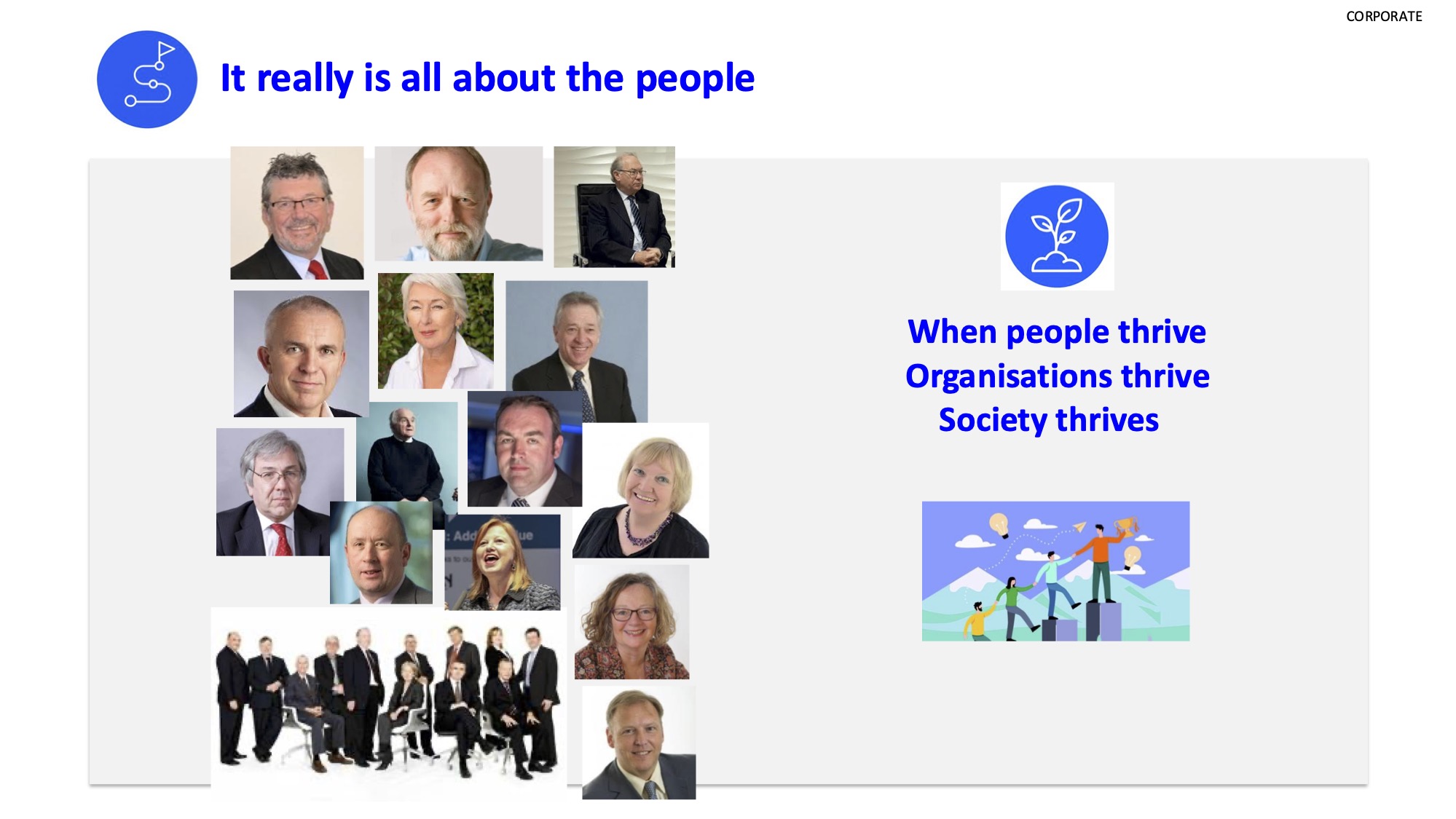
The future of sustainable FM: priorities and progress to 2030

The next five years will be decisive as technology, regulatory expectations and workplace demands evolve. FM providers and their clients need to strengthen partnerships, invest in skills and align commercial models to unlock the full value of sustainability-driven change.

Author: Sunil Shah, Managing Director, Acclaro Advisory

As the FM sector faces an era of unprecedented environmental, social and regulatory change, the SFMI Sustainable Ambitions Report 2026 assesses how sustainability priorities are likely to evolve by 2030. The report focuses on four core themes that are shaping the sector’s future: Decarbonisation, Wellbeing, Social Value, and Risks & Opportunities. By adapting an ‘Expectations Curve’ model based on Gartner’s Hype Cycle, the report charts the maturity of each theme, examines recent developments and identifies the changes expected over the next five years.

The next five years will be decisive as technology, regulatory expectations and workplace demands evolve.

The analysis draws on Acclaro Advisory’s expertise, publicly available research, the annual SFMI benchmarking programme and insights from the SFMI Leaders Working Group. Collectively, these sources provide a clear picture of where leading FM providers are already heading - and how the rest of the sector is likely to follow.

The next five years will be decisive as technology, regulatory expectations and workplace demands evolve. FM providers and their clients need to strengthen partnerships, invest in skills and align commercial models to unlock the full value of sustainability-driven change. The report urges leaders to move beyond discussion and into coordinated, rapid action.


Progress of the FM Sector
Although public discourse often portrays sustainability as polarising, organisational progress continues. Many businesses continue to implement their sustainability plans, albeit with less publicity, and while some have revised overly ambitious short-term targets, most remain actively engaged in long term transition activities.

Globally, there is strong regulatory alignment around a climate first agenda, reinforced by major frameworks such as ISSB, CSRD, California’s climate disclosure bills (SB253 and SB261), CDP, GRI and ISO 14001. This alignment is pushing organisations toward more evidence-based sustainability strategies.

Short-term trends indicate that sustainability is becoming a core strategic driver. However, inconsistent procurement practices and contract management processes are limiting progress. At the same time, external scrutiny is increasing; customers, investors and regulators are conducting more independent audits to counter greenwashing; and organisations must increasingly verify climate and social impact data to substantiate their claims.

Despite these shifts, FM frameworks are not yet structured to fully support the evolving sustainability landscape. Nonetheless, sustainability propositions are maturing and are increasingly grounded in clear business case justification rather than narrative alone.

External scrutiny is increasing; customers, investors and regulators are conducting more independent audits.

Main findings

Decarbonisation

Despite the sector’s progress, the last five years were marked by a high-profile retreat from early net zero commitments. Many organisations over-promised without fully understanding the scale of the operational, technical and financial changes required. As ambitions reset, FM providers nonetheless continued advancing practical decarbonisation, supporting clients in developing energy efficiency and decarbonisation plans - now held by 57% of organisations, up from 37% in 2023.

Carbon measurement has strengthened through frameworks such as the GHG Protocol, SBTi and ISSB S2, and electrification and renewable energy uptake continue to rise. However, reductions in operational emissions have been modest, hindered by misaligned projects and over-reliance on like-for-like replacements.

Outlook to 2030
By 2030, the sector is expected to move firmly into the Integration & Optimisation stage. SFMI data already shows frontrunners shifting from ambition to execution, integrating decarbonisation into financial planning, improving Scope 3 data quality and emphasising evidence-based decision making.

  1. All projects aligned to decarbonisation roadmaps
    Misaligned, like-for-like replacements will diminish as FM providers build stronger technical and project management capabilities. Clients and providers must jointly challenge legacy assumptions, supported by robust business cases.
  2. More collaborative, less transactional client-provider relationships
    Decarbonisation will continue to be client-driven, but progress will depend on deeper partnerships where clients share sustainability goals early and FM providers influence design, procurement and operational decisions.
  3. Service-level emissions to become a key decision driver
    Calculation of emissions per service line (e.g., cleaning, security, maintenance) will rapidly develop, enabling more mature procurement choices and benchmarking.
  4. Regulations shifting to operational performance
    A move from design-based to in-use energy performance standards is expected, with improved enforcement of existing schemes like ESOS.


Wellbeing

Wellbeing surged up the business agenda during and after the pandemic. FM providers improved understanding of environmental, physical and psychological wellbeing factors using staff feedback, technology and focused interventions. They also recognised that wellbeing must be addressed not only through design, but through cultural alignment, between behaviours and the physical environment.

Certifications such as WELL, FITWEL and BREEAM provided useful frameworks, yet evidence linking workplace design to measurable productivity and wellbeing outcomes remains underdeveloped.

Outlook to 2030
By 2030, wellbeing is expected to peak at the Ambition & Branding stage, as organisations pursue more holistic and evidence-based approaches. Psychological wellbeing will gain greater prominence, and a more robust evidence base will support clearer standards.

  1. Standardised wellbeing KPIs, with emphasis on mental health outcomes
    By 2030, agreed metrics such as reduced absenteeism and improved mental health are expected to become core organisational priorities. This shift requires deeper post-occupancy studies to verify the causal relationship between workplace features and human outcomes.
  2. Increased use of technology for real-time monitoring
    As KPI clarity improves, demand will surge for digital tools that measure, analyse and optimise workplace conditions in real-time - creating new market opportunities for FM providers.
  3. Mainstreaming of biophilic and circular design in existing buildings
    Techniques such as living walls, green roofs, design for disassembly and material passports will be incorporated more widely into refurbishments. These help future-proof buildings, support wellbeing and enhance asset value.


Social Value

Following the Public Services Act (2012) and further driven by the Procurement Act 2023 and Procurement Policy Note 002, social value has become firmly embedded in FM. SFMI assessments show rising sophistication, but major gaps persist. Chief among these is the limited inclusion of Tier 2 and Tier 3 suppliers, especially in people-intensive services like cleaning, catering and security, where the greatest potential social value often lies.

Inconsistent methodologies have led to social value scores ranging from 5% to 50% of turnover - eroding trust in reported numbers.

Outlook to 2030
Social value is expected to mature as inflated expectations stabilise. Social value will remain important, but organisations will shift from quantity to meaningful, business-relevant impact.

  1. Harmonisation of social value methodologies
    Consistency and comparability will increase as clients demand credible calculations. Tier 1 providers will need to support lower tier suppliers in measuring and reporting their contributions, requiring new resourcing models.
  2. Longer-term outcomes incorporated into social value assessments
    Metrics will extend beyond short-term inputs to include sustained employment, upskilling and longer-term community benefits. This will likely prompt longer contract periods.
  3. Alignment with local needs and national priorities
    Social value initiatives will be shaped jointly by local communities and national government goals, mirroring successful models such as Scotland Excel.
  4. Social value reporting embedded in financial accounts
    As reporting formalises, senior leaders will treat social value as a strategic driver, not just a tool to win bids. Supply chain performance will become a material part of disclosures.


Risks & Opportunities

Risk management remains immature across much of FM. Focus has been skewed toward physical climate risks, with insufficient attention given to transition risks (policy changes, market shifts, supply chain disruption). Modern slavery risk, despite being highly relevant to FM’s labour-intensive supply chains, is still handled through light-touch assurances rather than rigorous verification.

In contrast, thinking around opportunities has developed rapidly. FM businesses have enthusiastically expanded into areas like decarbonisation services, asset optimisation, wellbeing solutions and AI enabled efficiency.

Outlook to 2030
Risk management becomes more strategic and long-term thinking becomes standard.

  1. Greater long-term, strategic risk planning
    Organisations will better integrate impact and financial materiality and establish structured systems to monitor risks across multiple time horizons.
  2. Stronger focus on transition risks
    Regulatory change, carbon pricing, value-chain disruption and market shifts will become core considerations rather than peripheral concerns.
  3. Tighter auditing and reporting of modern slavery
    Regulation is expected to tighten, reducing reliance on supplier assurances and requiring deeper supply chain verification - including lowered participation thresholds.
  4. AI elevating human-centric roles
    AI will not replace core FM roles such as electricians, maintenance professionals or front-line staff. Instead, it will increase their value. The sector must position FM as a ‘safe haven from AI’ to tackle skills shortages, while office-based staff will need to invest in human skills to remain competitive.


Cross-cutting recommendations
Across all four themes, the SFMI identifies a set of systemic capability gaps that must be addressed for the FM sector to meaningfully advance by 2030. These recommendations form the foundation of a sector-wide shift toward integrated, strategic sustainability.

  1. Strengthen client ownership of sustainability strategies

Clients must take a more active role in setting direction, enabling FM providers to align delivery models. Longer-term contracts or partial insourcing may be required to maintain continuity.

  1. Reform procurement to reduce noise and greenwashing

Tender processes should consolidate overlapping requirements, remove incentives that reward inflated claims and promote transparency.

  1. Adopt new commercial models to unlock technology-enabled decarbonisation

Short-term commercial structures are misaligned with the investments needed for data-driven, technological solutions. Flexible, longer-range models are needed.

  1. Develop systems-based sustainability skillsets

Sustainability cannot remain siloed. Operations, procurement, finance and project teams must all develop integrated capability.

  1. Improve data quality for strategic decision-making

Better data will enable leaders to track progress, allocate investment more effectively and increase trust in decarbonisation, wellbeing and social value outcomes.

  1. Apply existing frameworks and regulations more effectively

Many tools already exist - GHG Protocol, WELL, ESOS, social value frameworks - but are inconsistently used. The sector must shift from viewing frameworks as compliance tools to using them for continuous improvement.

How SFMI is supporting this
We work directly with leaders across the sector, using a structured improvement framework combined with expert engagement and peer collaboration to drive progress. We challenge organisations to raise their performance by auditing and validating mature businesses through our certified assessment process and by offering an online self-assessment tool for those earlier in their sustainability journey or supply chain.

We are actively looking at how these recommendations can be progressed within the sector across clients, FM providers, professional institutes and procurement teams. To learn more or to get involved in the programme, please see the SFMI website.


Download Presenter Slides

Watch Recorded Presentation
Why FM needs to get serious about standards

Our message is simple: use existing standards more deliberately, and get involved in shaping what comes next. Standards help FM deliver today – while staying ready for what’s ahead.

Authors: Mark Griffiths, Founder & Managing Director, WMA Consultancy and Gordon Mitchell, Founder, WHOLUS

Facilities management is being pulled in more directions than ever. Our view is simple: if FM wants to be taken seriously in a disruptive world, it needs to get serious about standards.  Not as a tick‑box exercise, but as a practical way to make better decisions, manage risk and deliver workplaces that actually work.

Why this matters now
FM is under pressure from costs, skills shortages, regulation and rising expectations. At the same time, digital, data and AI are moving faster than traditional FM contracts, operating models and governance.

From our perspective – one foot in standards and governance, the other in live projects – FM has a choice. Either it uses standards to create clarity and credibility, or it waits until rules are imposed from elsewhere.

What standards really do
When used properly, standards are not bureaucracy. They do four very practical things:

  • Provide a structured way to manage change, using proven methods rather than one‑off fixes
  • Create a shared language between clients, FM teams and suppliers, reducing ambiguity and dispute
  • Strengthen risk management and assurance, which boards increasingly expect
  • Support continuous improvement, rather than ‘this is how we’ve always done it.

When used properly, standards are not bureaucracy.

That is why we see standards as one of FM’s most under-used governance tools.


Connecting standards to real FM
FM standards are shaped by real‑world practice and, in turn, shape how FM evolves. Strategic standards keep FM aligned with regulation and adjacent disciplines such as construction and asset management. Technical standards address maintenance, performance, workplace strategy and digital information across the asset lifecycle.

Current work on information management, soft landings and digital FM is about one thing: reducing fragmentation so systems, data and teams work together, not in silos.

FM standards are shaped by real‑world practice and, in turn, shape how FM evolves.

Governing digital and AI
AI and smart technology promise a lot, but capability without governance is risk. Standards provide the foundations for defensible digital FM:

  • Consistent data structures and terminology
  • Clear expectations around transparency, ethics and explainability
  • Interoperability and future‑proofing, avoiding vendor lock‑in and ‘black box’ outputs.

For clients, this means greater assurance.  For providers, fewer arguments about what the data really shows.


People, capability and data
As experienced leaders move on, and roles become more digital and cross‑functional, competency‑based standards help define what ‘good’ looks like. They support succession, capability-building and the translation between strategy and delivery.

Data standards are equally critical. Without common definitions and governance, better tools will not deliver better outcomes. Done well, data standards enable FM to move from reactive firefighting to insight‑led, whole‑life value.

Call to action
Standards are written by people in the industry, not handed down from above. Clients, providers and advisors all have a stake in how FM evolves.

Our message is simple: use existing standards more deliberately, and get involved in shaping what comes next. Standards help FM deliver today – while staying ready for what’s ahead.

Mark Griffiths is volunteer chair of BSI FMB/1 Facilities Management Strategy Committee.  Gordon Mitchell is chair and convenor of various BSI, ISO & CEN Standards committees for both facilities management and the built environment.


Download Presenter Slides

Watch Recorded Presentation
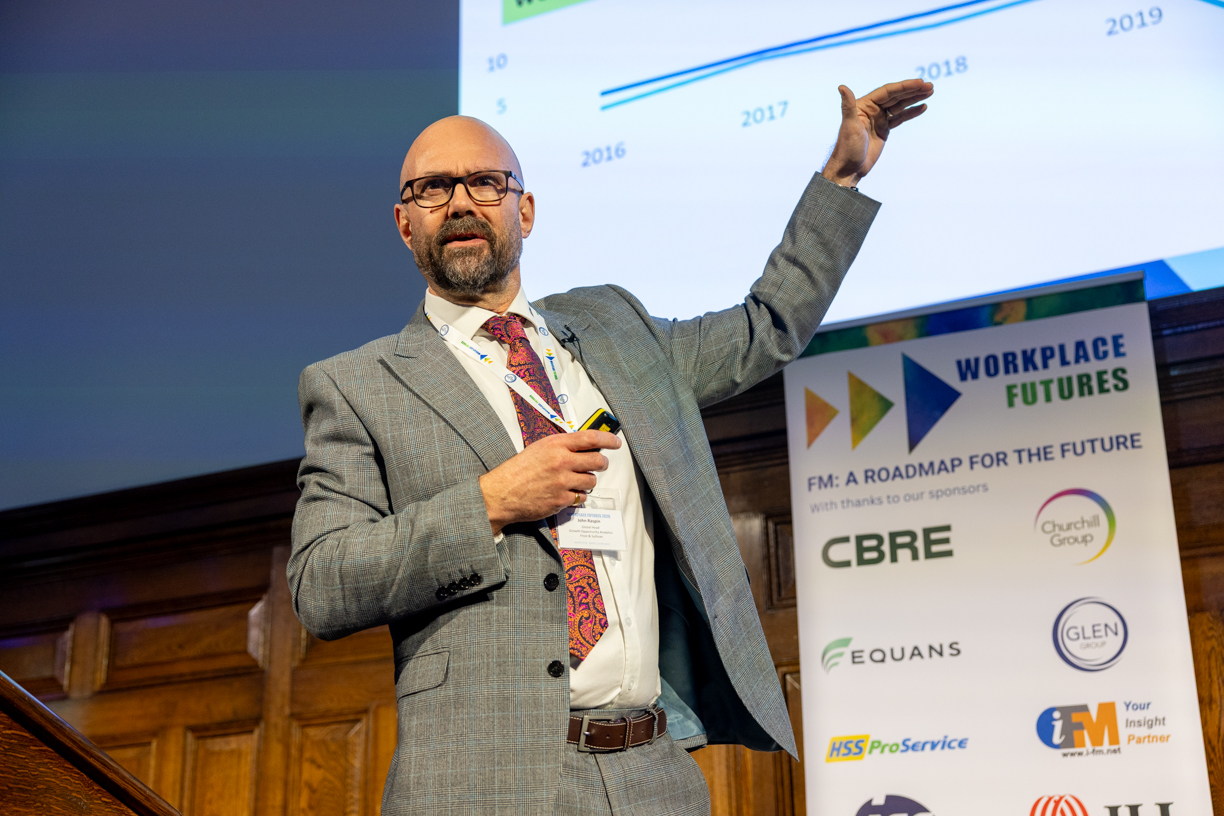
Why leadership capability is now critical infrastructure

Many organisations are investing heavily in technology, and rightly so. The risk lies in assuming leadership capability will naturally expand to meet its demands. Evidence suggests it does not.

Author: Louisa Clarke, Co-founder & Director, The Human-centric Workplace

Technology expands what facilities management can do. Leadership determines whether any of it delivers value. Treating these as sequential investments - technology first, people later - is not a strategy. It is a risk.

The future of facilities management is often framed as a technology story, but that framing only tells part of the truth. Artificial intelligence, smart buildings, automation and data are reshaping the sector at pace and investment is following as organisations modernise estates and digitise operations.

Accountability does not sit with the system. It sits with the leader.

What is less visible is the reality this creates. Across FM, modern platforms now sit alongside ageing estates, advanced systems operate next to manual work-arounds, and long-term contractual obligations remain in place while expectations continue to rise. This is not transformation on a blank canvas. It is change introduced into already complex environments.  In that context, performance is not defined by the sophistication of the systems in place, but by the quality of leadership operating around them.

Strip away strategy papers and digital roadmaps, and FM is still defined by moments of decision. A building is not functioning, a client is waiting, conflicting inputs require a call to be made quickly and with incomplete information. In that moment, accountability does not sit with the system. It sits with the leader.

Operational reality
Technology can inform a decision. It cannot own one. Accountability sits with the person, not the platform.

Many organisations are investing heavily in technology, and rightly so. The risk lies in assuming leadership capability will naturally expand to meet its demands. Evidence suggests it does not.

While digital infrastructure and artificial intelligence continue to attract significant investment, far less is directed towards developing the people expected to lead within these environments. Recruitment and retention challenges remain, and fewer than half of FM organisations report having a formal people development strategy in place (IWFM, 2025).

Performance in FM is delivered through the decisions leaders make about priorities, risk, people and commercial outcomes, often simultaneously and under sustained pressure. When leadership capability does not keep pace, the impact builds gradually as decisions slow, confidence weakens and issues surface later than they should. By the time the consequences are visible, organisations are already exposed.

FM has never lacked capable individuals, and the sector continues to be defined by resilience, commitment and the ability to deliver under pressure, something demonstrated clearly during the pandemic when critical services continued to operate despite unprecedented disruption. However, capability at an individual level does not automatically translate into effective leadership at scale.

The challenge lies in how leadership is developed. Progression within FM still too often follows familiarity rather than readiness, with individuals promoted for technical expertise or tenure and then expected to lead in complex, commercially exposed environments without the structured development required to do so effectively.

Leadership capability is being left to chance in environments that cannot afford it.

Systemic issue
This is not a failure of individuals. It is a failure of design. Leadership capability is being left to chance in environments that cannot afford it.

Addressing this requires more than additional training. It requires a shift towards deliberate design, where leadership development is treated with the same intent, investment and accountability as technology programmes.

Technology continues to expand what is possible, but it does not reduce the need for leadership. It increases it. As artificial intelligence, connectivity and data accelerate change, the demand for sound judgement, clarity and communication under pressure becomes more critical, not less.

Systems can provide data, but they do not remove ambiguity. Automation can reduce tasks, but it does not remove responsibility. Artificial intelligence can identify patterns, but it cannot explain them when outcomes fall short. Leadership remains the point at which accountability sits.  At the same time, many organisations continue to treat investment in people as secondary to investment in technology, as though one represents cost and the other a driver of value. This is a false distinction. Leadership quality is the single greatest influence on team performance, with up to 70% of employee engagement attributable to the immediate line manager (Gallup, 2025). Organisations that invest in leadership development outperform those that do not across productivity, retention and financial outcomes (McKinsey, 2024).

The conditions that underpin sustained performance, including trust, clarity and the ability to surface issues early, are created by leadership behaviour. No system can compensate for its absence.

Evidence
Up to 70% of employee engagement is driven by the quality of the immediate manager, not culture programmes, not technology, not pay alone. Leadership is the lever.

If leadership capability is now critical infrastructure, it must be treated as such. This requires a move from assumption to design. Organisations must move beyond informal progression and build leadership capability deliberately, with clear expectations and structured support.

In practice, this involves developing leaders who can maintain clarity under pressure, align operational delivery with commercial reality and communicate effectively in high-stakes environments. It also requires leadership capability to be embedded within technology transformation, ensuring that investment in systems is matched by investment in the people required to lead within them.

This is not abstract. Poor management is estimated to cost UK organisations £84 billion per year in lost productivity (CMI, 2024).

Leadership capability is not a soft consideration. It is a commercial one.

The principle
Every technology investment should be paired with an equivalent investment in leadership capability. One without the other is not transformation; it is risk dressed as progress.

FM has always understood visible risk, investing heavily in compliance, buildings and systems because failure in those areas is measurable and immediate. Leadership risk behaves differently. It builds over time in contracts under pressure, in teams that disengage and in client relationships where trust begins to erode before the cause is fully understood.

The financial impact is significant, with disengaged employees costing UK organisations approximately £340 billion annually in reduced output (Gallup, 2025). Leadership capability is not a soft consideration. It is a commercial one.

As organisations continue to invest in technology, digital infrastructure and artificial intelligence, there is a fundamental question that must be asked alongside those decisions - not simply whether systems are ready, but whether the organisation is equipped to lead within the environment those systems create.

The future of FM will not be defined by who adopts the most advanced technology, but by who develops leaders capable of operating effectively in sustained complexity, making sound decisions under pressure and creating the conditions in which both people and technology can perform at their best. Those organisations that recognise leadership capability as critical infrastructure will not simply adapt to the future of FM. They will define it.

References
IWFM (2025), Workforce Insights: People and Skills in FM.
Gallup (2025), State of the Global Workplace.
McKinsey (2024), Performance Through People.
CMI (2024), Management Transformed.


Download Presenter Slides

Watch Recorded Presentation
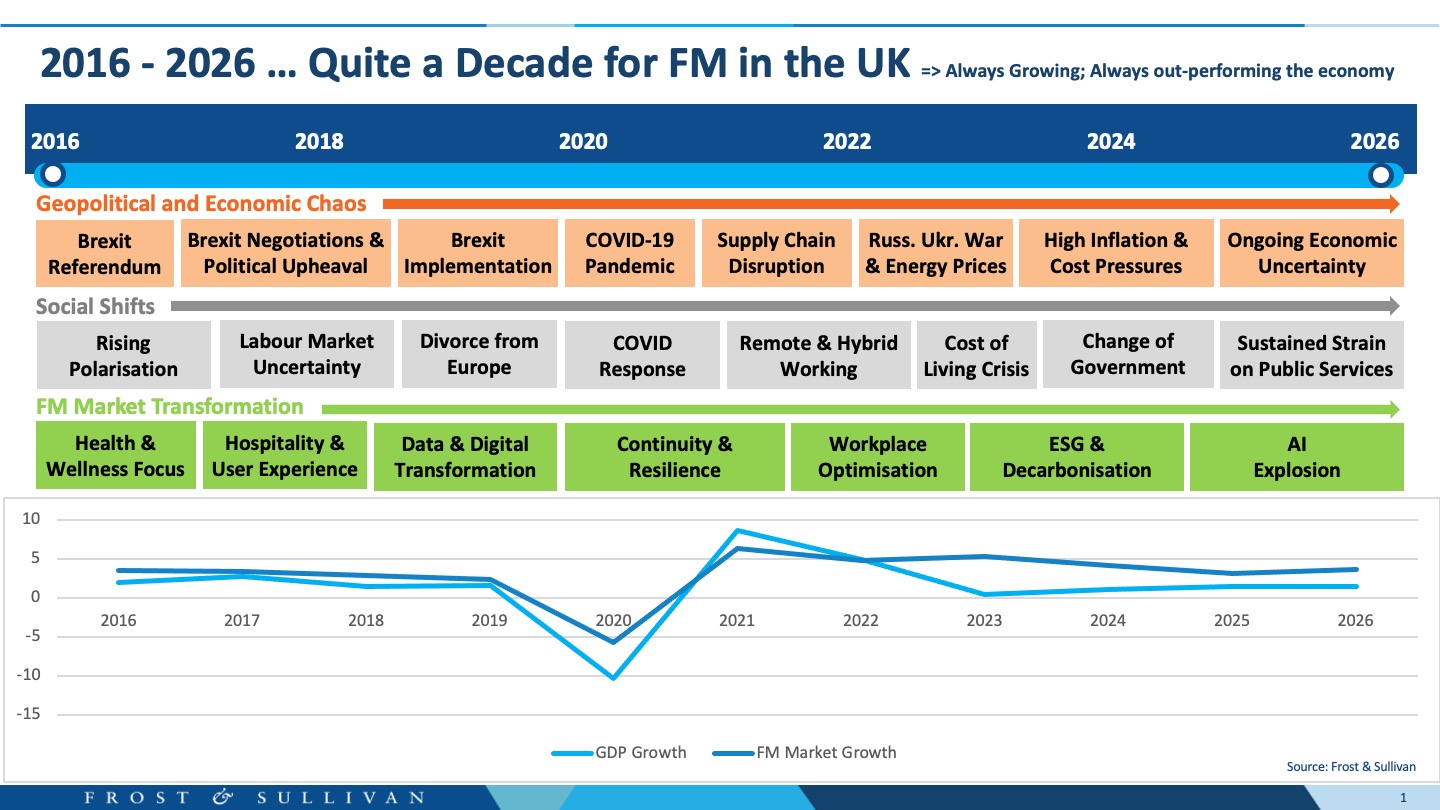
Are we giving the next generation of leaders the opportunity to own their future and lead ours?

As the current generation of senior leaders moves on, the industry faces broader questions about whether our model is human-centric enough, about financial sustainability in a competitive market, and about how EDI and ESG ambitions translate into how we develop and promote people.

Author: James Bradley, CEO, Churchill Group 

FM is an industry built on experience. And right now, the people who hold that experience are, in significant numbers, approaching the end of their careers.

This creates an urgent problem. With skills shortages across FM, fewer people actively planning long-term careers in our sector and a senior cohort approaching retirement, the question of who leads us next isn't just some abstract HR concern, but a critical operational challenge.

Addressing the loyalty myth
A narrative has been building that younger generations simply aren't loyal – that Gen Z job-hop by default and that investing in their development might therefore be money wasted. The evidence doesn't support this. A survey by talent development company Right Management found that 53% of Gen Z employees in the UK plan to stay with their current employer for one to five years, a higher proportion than Millennials, Gen X or Boomers.

According to Deloitte research, 90% of Gen Z and Millennial workers say employer values matter for their satisfaction – clear evidence that purpose and alignment affect retention. The same research shows Gen Z has high levels of confidence in their line managers when discussing career development, which matters enormously if we want those conversations to happen. Younger people will stay, but only if they can see a future.

The question of who leads us next isn't just some abstract HR concern, but a critical operational challenge.

Training and development rank consistently as a top motivator for young workers and are strongly linked to engagement. Purpose and growth matter as much as pay. That shifts the question from ‘how do we retain Gen Z?’ to ‘are we giving them a reason to stay?’

The cost of doing nothing
If FM organisations don't invest in developing the next generation of leaders, the consequences follow a predictable sequence: leadership gaps emerge suddenly rather than being managed proactively, high-potential people disengage quietly and leave without announcement, and FM knowledge walks out the door faster than it can be replaced.

Still, it’s important to remember careers are no longer linear. The pace of technological change means the skills needed today are different from the skills needed five years ago. In that context, development is about more than progression – it also signals belief and trust. When an organisation invests in someone's growth, it tells them they have a future here.

Ownership changes mindset
At Churchill Group, being an employee-owned business shapes how we think about this. When employees are long-term stakeholders, success is shared and responsibility feels personal. That is the environment in which genuine leadership development takes root.

When an organisation invests in someone's growth, it tells them they have a future here.

It informed the development of our Own Your Future programme, which we built specifically for current and aspiring managers. The programme combines six modules with one-to-one mentoring and is grounded in real-world FM leadership scenarios, with clear and explicit links to succession. We were determined to build more than a tick-box exercise. It has been designed to support actual progression.

The results have been encouraging. 13% of participants have been promoted since completing the programme. The cohort spans an age range of 26 to 62, is 54% female and 46% male, and 69% identify as non-white British, which reflects our commitment to ensure our leadership pipelines draw from the full diversity of our workforce. Since becoming employee-owned, Churchill Group has seen a 30% reduction in attrition, and our employee ownership base is growing at 12.5% blended year-on-year.

What makes it work is the combination of real FM scenarios that feel relevant to participants, peer support and mentoring that builds relationships alongside skills, and a clear connection between the programme and actual opportunities within the business. Ownership creates connection and development creates confidence. Together, they create the conditions for loyalty.

Tomorrow's leaders are already on site
The leaders FM needs are not somewhere else. They are supervisors, contract managers and aspiring leaders already working in our industry. The question is whether we are creating the conditions for them to step forward.

Capability requires investment in the people who are already there.

As the current generation of senior leaders moves on, the industry faces broader questions about whether our model is human-centric enough, about financial sustainability in a competitive market, and about how EDI and ESG ambitions translate into how we develop and promote people. None of those questions resolve themselves.

Commitment needs capability. And capability requires investment in the people who are already there, already committed and already waiting for someone to back them.


Download Presenter Slides

Watch Recorded Presentation
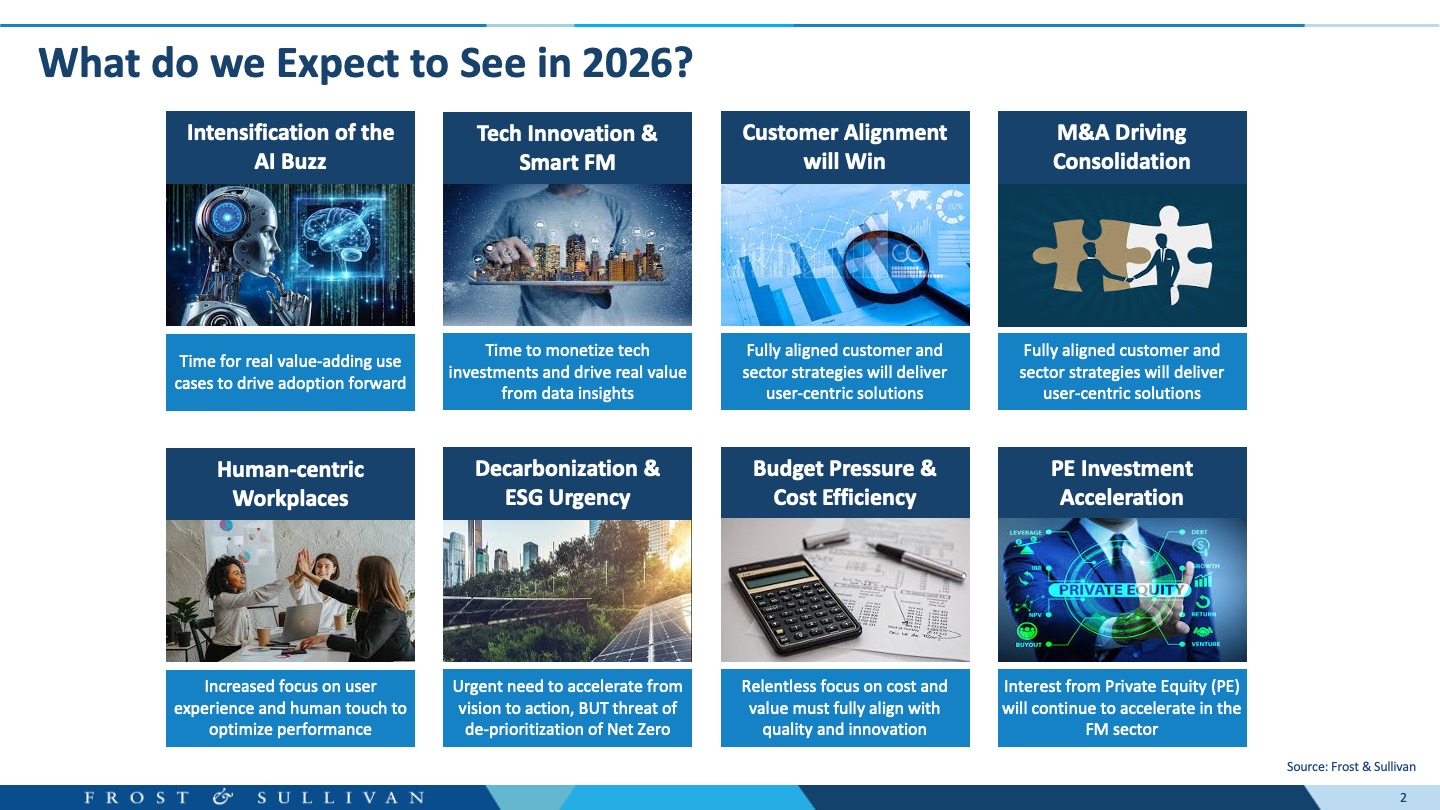
Nurturing the FM ecosystem

A resilient ecosystem depends on renewal at its base. The presence of new entrants creates competition, innovation and opportunity. It also sustains the pipeline of future leaders and future national providers.

Author: Simon Wrenn, CEO, Kindred FM       

The UK facilities management sector faces a series of significant challenges, including technological disruption, rising employment costs, regulatory complexity and shifting client expectations. However, the most important determinant of the sector’s long-term health is neither technology nor legislation. It is people.

The FM sector must focus on renewing its ecosystem from the bottom up. Without a steady flow of new entrants, entrepreneurs and ambitious operators, the entire industry structure weakens over time. By improving exposure to opportunity, encouraging entrepreneurship and promoting the sector more effectively to young people, the FM industry can strengthen its resilience, reputation and long-term performance.

The FM ecosystem
The facilities management sector can be understood as an ecosystem. It is composed of interdependent organisations operating at different scales, each influencing and supporting the others.

Dynamism is a sign of health.

At the base are owner operators. Often one person with a van and a small number of contracts, these businesses represent the entry point into the industry. Above them sit small and medium sized enterprises operating across local and regional markets. Beyond these are larger regional providers, national operators and, ultimately, international and publicly owned corporations.

Movement through this structure is constant. Owner operators grow into SMEs. SMEs expand regionally. Regional providers become national players. Larger organisations acquire smaller firms to broaden their service offering or geographic reach. Individuals also move between organisations, bringing experience and leadership capability across the sector.

This dynamism is a sign of health. A resilient ecosystem depends on renewal at its base. The presence of new entrants creates competition, innovation and opportunity. It also sustains the pipeline of future leaders and future national providers.

Historically, FM has benefited from relatively low barriers to entry in many service lines. Window cleaning rounds, grounds maintenance contracts, cleaning services and electrical or plumbing businesses have all provided practical and accessible starting points. From these modest beginnings, significant companies have been built.

The continued strength of the industry depends on preserving this flow.

The renewal gap
The UK is approaching a demographic inflection point. In 2023, there were 991,432 self-employed individuals aged 60 or over. Research indicates that only 36% of SME owners in this age group have a clear succession plan.

This creates a renewal gap. As a significant cohort of business owners approaches retirement, there is insufficient evidence that a comparable wave of new entrepreneurs is emerging to replace them.

Many young people do not naturally view FM as an aspirational sector.

If the base of the ecosystem contracts, the impact extends beyond small firms. Fewer start-ups mean fewer growing SMEs. Fewer SMEs mean fewer future regional providers and acquisition targets. Career pathways become less dynamic. Leadership opportunities narrow. Client choice reduces.

Over time, this can affect service standards and innovation. What begins as a shortage of new entrants can become an industry-wide constraint.

A perception challenge
The renewal gap is compounded by a perception issue. Many young people do not naturally view FM as an aspirational sector.

This is not necessarily a reflection of opportunity within the industry, but of visibility. Research shows that nearly 60% of young people express a desire to start a business, yet only 16% go on to do so. Only around 35% report receiving business start-up guidance at school.

The ambition exists. The exposure often does not.

At the same time, structural factors are reshaping career decisions. Artificial intelligence is beginning to affect white-collar graduate roles. Youth unemployment levels have risen relative to European peers. The cost of university education, combined with interest charges and long-term repayment obligations, is influencing perceptions of return on investment.

These conditions present both risk and opportunity. Practical industries such as FM can offer leadership, ownership and independence. However, unless these pathways are clearly articulated and visible, they remain under-recognised.

The ambition exists. The exposure often does not.

The power of exposure
Industry renewal does not depend solely on policy or funding. It often begins with individual influence.

Entrepreneurs frequently cite a moment of exposure that altered their perception of what was possible. Seeing someone build a business, manage clients or create employment can plant the idea that such a path is attainable.

The FM sector contains many such examples. Owner-operators who have built substantial enterprises. Managers who have progressed into leadership. Individuals who have created financial independence and social mobility through practical service provision.

These stories are powerful, yet they are not consistently shared beyond the sector.

If the industry fails to present visible and credible examples of success, it risks reinforcing the perception that FM is transactional rather than entrepreneurial.

These stories are powerful, yet they are not consistently shared beyond the sector.

Strengthening the base
Renewing the FM ecosystem does not require a centralised initiative. It requires collective intent.

There are practical steps that organisations and individuals can take:

  • Offering apprenticeship opportunities and structured work experience placements
  • Engaging with local schools and colleges to explain career pathways
  • Mentoring aspiring entrepreneurs or junior managers
  • Identifying entrepreneurial talent within existing teams and supporting internal ventures
  • Communicating with greater pride and clarity about the profession.

These actions strengthen the base of the ecosystem. They encourage entry, ambition and progression. Over time, they expand the pool of capable leaders and business owners.

I have initiated a schools competition called Future Founders to encourage entrepreneurial thinking among 13- to 18-year-olds. The programme provides a structured framework for developing a business idea and offers funding and recognition to participating schools. While modest in scale, it reflects a broader principle. Exposure to entrepreneurship at an early stage can change perceptions of what is possible.

The wider objective is not tied to any single initiative. It is to normalise the idea that facilities management is a viable route to ownership, leadership and long-term success.

Conclusion
The facilities management sector is often evaluated through the lens of cost, compliance and operational efficiency. These factors are important. However, the long-term resilience of the industry rests on its human capital and its capacity for renewal.

An ecosystem that continually generates new entrants, nurtures growth and enables progression will remain competitive and adaptable. An ecosystem that fails to renew risks stagnation.

The responsibility for renewal sits across the industry. By improving exposure, encouraging entrepreneurship and presenting a clearer narrative about opportunity within FM, the sector can strengthen its future.

The question is not whether renewal is necessary. It is whether the industry chooses to act collectively to support it.


Download Presenter Slides

Watch Recorded Presentation
From partners to change-makers – tackling the net zero challenge together

As organisations face increasing regulatory expectations, investor scrutiny and rising ESG requirements, operational partners are playing a bigger role in helping organisations make practical, measurable progress.

Authors: Claire Atkins Morris, sustainability and workplace culture director, Sodexo UK & Ireland

The most complex element of net zero transition lies in Scope 3 emissions – those generated across supply chains rather than within owned assets. In healthcare and facilities management, these emissions account for the vast majority of organisational carbon footprints, making collaboration a key lever to decarbonising business operations.

Both the NHS and its suppliers, including Sodexo, have set out net zero supplier roadmaps to tackle emissions over which they do not have direct control.  Through their collaborative efforts, the NHS and Sodexo are driving meaningful change and bridging the gap between client and supplier to become not just partners but change-makers as they strive to achieve climate and sustainability goals.

From partners to change-makers
With similar challenges, it became clear that each organisation could learn from the other, and it was this realisation that led to the formation of the ‘sustainability community of practice’.  Sodexo partnered with FuturePlanet to support its vision to foster a community of like-minded individuals from a wide range of organisations with the aim to collectively achieve climate, nature and social goals.

What began in 2023 as an informal conversation between a small group of sustainability leads has grown into a network with around 60 members from organisations of various size and from varying industries.

The value of the community lies in its openness: the community of practice demonstrates that beyond formal frameworks what is of real importance are strong relationships and shared learning. Glossy ESG narratives are set aside in favour of honest discussion about what is working, what is not and where organisations need support.

For the NHS, the community has helped break down traditional client–supplier boundaries. While Sodexo is a supplier to the NHS, the challenges both organisations face are often the same. By moving beyond transactional relationships to become collaborators and, ultimately, change-makers, members are demonstrating how progress happens when clients and providers work through shared challenges together.

The community also plays a vital role in supporting individuals working in sustainability roles. According to the 2025 ISEP State of the Profession report, these roles are rapidly evolving to include a wider remit covering topics like social impact, community engagement and climate adaption. The report revealed 40% of sustainability professionals are experiencing a shift in responsibility - what was once a role that focused on compliance and waste management today requires them to navigate complex political landscapes, balance organisational values with market demands, and possess strong business acumen. By connecting people across disciplines and career stages – including procurement, operations and sustainability – the community of practice is providing peer support, diversity of thought and practical problem-solving.

Progress happens when clients and providers work through shared challenges together.

Tackling the hardest emissions together
For the NHS, around three-quarters of emissions sit in Scope 3, driven by a vast and complex supply chain comprising tens of thousands of suppliers.  For Sodexo, 98% of its emissions sit in Scope 3 due to the nature of its business of delivering services on client sites rather than its own.

While the NHS had a clear commitment to net zero, the challenge was how to bring such a diverse supplier base on the journey in a consistent and credible way. The Evergreen Sustainable Supplier Assessment was developed as part of this effort and early piloting by suppliers, such as Sodexo, helped demonstrate how collaborative working can truly make a difference – as does sharing this with the market to encourage and support others in their net zero journeys.

The NHS Net Zero Supplier Roadmap was published in 2021 with the aim of giving its suppliers clarity as to what it expected of them over the next decade. With around 80,000 suppliers and a purchasing spend in the region of £35 billion on goods and services every year, the NHS has a significant challenge to support its supply chain to decarbonise. 

The roadmap set out a clear series of milestones covering net zero commitments, carbon reduction planning, social metrics and, ultimately, comprehensive emissions reporting across all relevant scopes. By aligning requirements to international standards, the NHS aims to avoid duplication and reduce unnecessary burdens for suppliers operating across multiple sectors, while moving its supply chain further towards net zero over time.

The roadmap is supported by the Evergreen Sustainable Supplier Assessment, an online benchmarking framework for suppliers to assess their maturity against NHS sustainability priorities.

Launched in June 2023, the Evergreen Assessment provides the NHS with greater visibility of supply chain emissions and progress. For NHS suppliers, it was created to streamline and simplify sustainability reporting and offers a clear pathway for improvement and recognition of leadership.

The maturity criteria are informed by leading, independent sustainability initiatives such as the Science Based Targets initiative (SBTi) and the modern slavery assessment tool (MSAT), as well as NHS sustainability requirements, including those set out in the net zero supplier roadmap.

Suppliers are assessed against four maturity levels which indicate alignment with NHS sustainability priorities:

  • Level 1: Publicly committed to net zero carbon and engaged with sustainability
  • Level 2: Comprehensive net zero targets and reporting for carbon emissions
  • Level 3: 2045 net zero targets that are independently validated
  • Level 4: 2045 net zero targets, independently validated, across the global organisation.


All NHS suppliers are required to complete the Evergreen Assessment, and from April 2026 suppliers must meet Level 1 of the assessment as a minimum standard to join new frameworks established by NHS Supply Chain. Currently, Sodexo is one of just 12 NHS suppliers at Level 4, demonstrating its high level of commitment and progress on sustainability.

Transparency is central to this approach.

Aligning ambition with clients
For Sodexo, the NHS approach acted as a powerful catalyst. Rather than treating the roadmap as a compliance exercise, Sodexo used it to align sustainability more closely with commercial strategy and client relationships.

By committing to science-based targets, transparent reporting and a supply chain engagement strategy aligned with the NHS Evergreen framework, Sodexo was able to avoid asking its own suppliers to respond to multiple, overlapping requirements. This alignment helped maintain trust and momentum, while strengthening long-term client relationships.

As organisations face increasing regulatory expectations, investor scrutiny and rising ESG requirements, operational partners are playing a bigger role in helping organisations make practical, measurable progress.

Transparency is central to this approach. Sodexo demonstrated this just a couple of years ago when its net zero report revealed it wasn’t making the progress it had hoped. Acknowledging that it clearly needed to do more, the company reviewed what it needed to do to shift the dial and put in an action plan to address it. Two years on and Sodexo is celebrating a milestone year in its net zero progress.

The company’s latest net zero progress report reveals how it is making significant progress, exceeding its short-term target to reduce all greenhouse gas emissions (GHG) by 34% by 2025, reporting a reduction of 44.5% at 31 August 2025. It has also surpassed its near-term target to cut Scopes 1 and 2 emissions by 55% by 2030, achieving a 68.9% reduction. Sodexo also reported that it had hit its goal to halve food waste by 2025 with a 50.2% reduction (across 85% raw material cost).

The benefits of Sodexo’s approach and commitment are increasingly tangible. With 54.9% of emissions arising from purchased goods and services, Sodexo’s supply chain of around 4,000 partners is a key action lever. 

Since its launch in 2023 the company’s award-winning net zero supply chain engagement strategy, which features tailored to support small and medium-sized enterprises and voluntary, community and social enterprises, has been well received with 97.6% of its in-scope supply partners engaged with the programme.

Designed to combine guidance, collaboration and mentorship, the strategy has helped Sodexo reduce total supply chain emissions by 24.6%. Since its launch, supply partners representing 78.2% of its in-scope supply chain emissions have now set SBTi-validated emissions reduction targets, and supply partners accounting for 93.9% of in-scope emissions have submitted data and carbon reduction plans.

Climate action today is as much a business priority as it is an environmental one.

This progress shows how Sodexo’s science-based approach is translating into practical, commercially meaningful solutions delivered every day through the services it provides. By embedding lower carbon practices into operations, Sodexo is helping clients, including the NHS, move faster towards their own net zero ambitions while strengthening resilience and long-term value.

Climate action today is as much a business priority as it is an environmental one. Clients are looking for practical solutions that help them operate more efficiently, meet rising expectations from investors and regulators, and future-proof their organisations.

Progress is only possible through collaboration. Together, we can accelerate change, deliver lasting value and reinforce our mission to help build a better future for our people, our planet and society.


Download Presenter Slides

Watch Recorded Presentation
From maintenance tasks to business outcomes: a practical guide to objective based maintenance for IFM leaders

Digital transformation is most credible when it produces results people can measure. OBM provides a practical approach to align customer expectations, operational decisions and sustainability goals, while improving capacity and protecting margin. 

Author: Nush Cekdemir, Director International Business, Planon

Digital transformation only matters if it improves the service outcomes customers value. More integrated facilities management service providers are therefore moving beyond ‘doing maintenance’ to delivering outcomes. These outcomes include safer sites, more reliable operations, stronger compliance, better use of budget and measurable progress on objectives such as sustainability performance. 

Objective based maintenance helps make this shift practical. It’s not a new layer of complexity. It is a clearer way to decide what work to do, when to do it, and why it matters.  

OBM means maintaining assets based on business priorities.

What is objective based maintenance? 


OBM means maintaining assets based on business priorities, rather than applying the same plan everywhere. Priorities vary by customer and site, but they typically include safety, uptime, cost control, energy performance, sustainability goals and regulatory compliance. OBM connects day-to-day decisions to these priorities, so maintenance becomes a driver of value.  

Why now? The pressures are rising on every side 
The case for OBM is strengthening because the operating environment for IFM is changing quickly:

  • Workforce pressures from skilled technician shortages and the risk of losing practical knowledge as experienced staff move on 
  • Commercial pressures are tightening from contract margin strain and the shift towards more increased performance expectations rather than simply paying for activity
  • Customer expectations are higher as critical environments (such as healthcare and data centres) demand reliability, occupants expect better experiences and customers increasingly ask for transparency and proof of compliance
  • Regulatory and oversight demands continue to increase, with stronger enforcement and higher expectations for audit readiness.

In this context, adding more scheduled tasks rarely improves results. Service providers outperform when they focus effort where it protects the most value and can show impact. 

OBM starts with trusted data (not more data) 
OBM depends on trusted data, not simply more data, because transformation efforts often fail when organisations collect information they can’t rely on. Trusted data requires clear ownership and standards, so definitions stay consistent. It also requires controlled sharing, so information flows across teams and systems. It needs reliable inputs, supported by checks that reduce errors. Finally, it requires strong protection so sensitive data remains secure and under your control.  

Better data creates clarity when three data layers come together. Operational history shows failures, response times, costs and repeat issues. Operating rules and customer constraints guide how work is prioritised and approved. Real-time signals highlight early performance drift, enabling earlier action. Together, these layers support faster decisions that align more closely with the outcomes customers rely on. 

Trusted data requires clear ownership and standards.

How to start with OBM: a simple executive playbook 
You don’t need to redesign everything at once. OBM works best when introduced step by step: 

  1. Group assets by what they protectsuch as safety, revenue, cost or sustainability.
  2. Define the outcomes for each groupand how these will be measured, such as expectations of availability, risk exposure, lifecycle costs or energy consumption 
  3. Match the maintenance approach to the critical level of the asset group -
  • For high impact assets, intervene earlier based on risk and performance signals
  • For medium impact assets, use planned routines where they deliver clear benefit
  • For low risk assets, accept ‘run until it fails’ where failure is manageable.
  1. Align scheduling and resourcing to business impact by prioritising work based on consequences, not just order of arrival 
  2. Implement continuous improvementby using performance feedback to reduce repeat issues and refine priorities over time. 


A real-world illustration: preventing disruption in a critical facility 
Consider a mission-critical cooling issue developing in a medical centre’s central plant. In an outcome-based model, the goal isn’t simply ‘repair the unit’. It is to protect patient safety, maintain continuity and avoid knock-on impacts.

This is where modern automation and AI can help by spotting unusual patterns (such as rising energy use with poor cooling), anticipating the likely consequence (a failure within days), summarising the ‘why’ for the team arriving on-site, and automatically coordinating next steps like creating work orders, booking the right resource and updating stakeholders. The value is faster decisions, lower risk, fewer disruptions and improved customer satisfaction. 

Digital transformation is most credible when it produces results people can measure.

Make transformation visible through outcomes 
Digital transformation is most credible when it produces results people can measure. OBM provides a practical approach to align customer expectations, operational decisions and sustainability goals, while improving capacity and protecting margin. A strong next step is to pilot OBM on one high-impact asset group, define outcomes, improve the data that matters and measure the results. Prove the value, then scale across asset groups and contracts.  


Download Presenter Slides

Watch Recorded Presentation
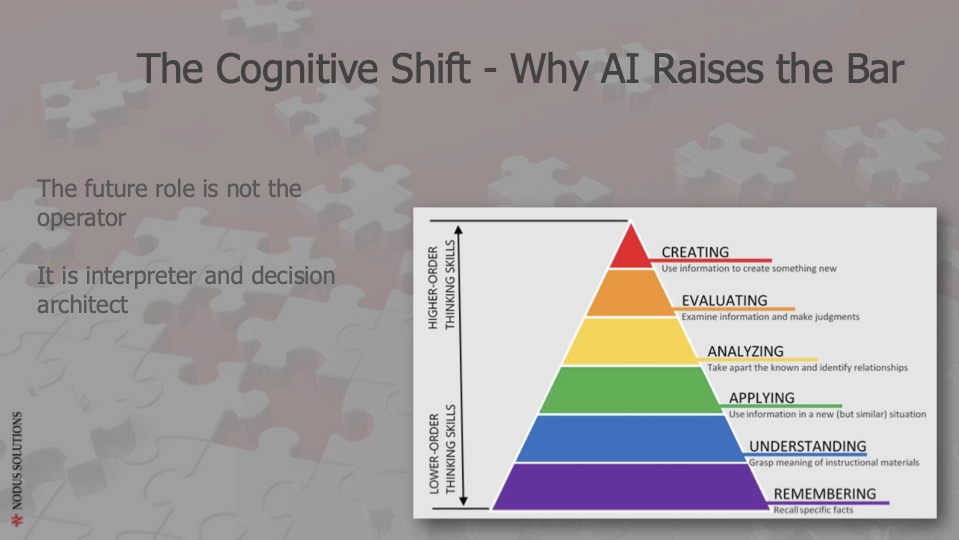
The power of partnership

Set against the future-focused conversations at Workplace Futures, Paul Dawson and Ryan Horton reflect on the power of partnership and how their collaboration challenges traditional FM models to become more flexible, adaptive and forward-thinking.

Authors: Ryan Horton, Business Unit Director, CBRE and Paul Dawson, Director of Facilities at Sky Studios Elstree

Sky Studios Elstree is a unique account for any facilities management partner. The 27-acre site is complex in nature with mixed use environments, including five sophisticated office buildings, 12 sound stages and four workshop buildings. The daily operational and resource requirements shift and flex according to production activity on-site and criticality changes depending on how the spaces are being used, not just what type of space it is.

What appears to be an empty warehouse to the uninitiated becomes a feature film set in a matter of months, and the FM delivery must rise to match the same level of ambition required by big titles such as Wicked and Jurassic Park. This variability in scope and the critical nature of the buildings and services creates risk for Sky Studios Elstree and its FM partner, but it also creates an opportunity for truly exceptional service delivery, which would be insurmountable without the foundation of a strong, trusted partnership.

What Sky needed
When Sky Studios Elstree started looking for a new FM partner in 2025, there were three key areas that a successful partner needed to provide in their service delivery.

First, Sky Studios Elstree has an ambition of becoming the world’s most sustainable studio. Therefore, they needed a partner who had sustainability expertise in studio spaces. They weren’t looking for generic policies, but industry-specific sustainability targets, plans and initiatives. Sky Studios Elstree selected CBRE as their partner partly due to CBRE’s ESG and sustainability credentials, and they were keen to act as an incubator for CBRE-led innovations.

Second, flexibility is a non-negotiable for Sky Studios Elstree, and a fixed model of FM just wouldn’t work in such a dynamic environment. An FM partner needed to understand the ‘shrink and swell’ nature of the scope on-site and plan services according to the production schedule. FM delivery teams need to fix issues before the production team even notice there is an issue, with the understanding that they are dealing with highly skilled individuals who may or may not already have a fix in mind. Film and television production is like a runaway train – once they start, nothing can get in the way of completing on time and on budget

Third, reliability is of utmost importance for such a complex and active estate. Data must be easily visible and reliable as it is key to decision-making. To support this, technical expertise must be readily available and on-site. Sky Studios is an estate that often runs around the clock and issues must be resolved rapidly to avoid downtime for production companies.

True partnership requires transparency, integration and shared accountability.

Partnership in practice
CBRE was awarded the multi-million-pound contract following a competitive tender, going live in January 2026 and delivering planned and reactive maintenance, cleaning and mailroom services. In an environment as operationally complex as Sky Studios Elstree, a strong, trusted FM partnership is fundamental to the success of its operations. A traditional, rigid and often transactional relationship would quickly show its limitations and struggle to keep pace with the daily shift in scope and requirements.

True partnership requires transparency, integration and shared accountability, not just at leadership level, but throughout the delivery teams themselves. At Sky Studios Elstree, this means having hand‑picked, technically capable people on-site who fully understand the environment they are operating in. During mobilisation, CBRE conducted a skills-gap analysis of the existing staff members and built a bespoke, robust training plan for each member of staff, to upskill the team and ensure they all have a high level of technical competence. This has not only increased resilience on-site, but has also driven retention and a sense of belonging within the Sky and CBRE team.

CBRE’s solution to Sky Studios Elstree’s three core challenges includes dedicated roles such as a sustainability and reliability manager, focused on upskilling engineering teams and driving both technical and sustainable innovation. It is reinforced through initiatives like the Elstree passport, which prioritises technical training and deep site knowledge, ensuring that only qualified, competent individuals are trusted to work within this highly complex estate.

In this relationship, trust has been built not through avoiding challenge but addressing it early. Open, sometimes difficult conversations are approached head-on and issues are addressed collectively, creating opportunities for continuous improvement and further strengthening trust. Over time, this way of working shifts the relationship between client and FM partner from reactive service delivery to a genuinely collaborative partnership. CBRE is an extension of the Sky Studios Elstree team, not just a supplier. In a tight-knit industry where word of mouth is king, keeping the showers of key cast members running and the studio lights on means repeat business and a protected reputation for this highly successful studio.  

Trust has been built not through avoiding challenge but addressing it early.

Outcomes
The benefits of a stable, trusted partnership are not always easy to quantify, but they provide a solid foundation from which to build a successful future for both people and place. For complex, high-pressure estates, this translates into greater resilience, reduced risk and a shared confidence in the ability to respond as operational demands evolve.


Download Presenter Slides

Watch Recorded Presentation
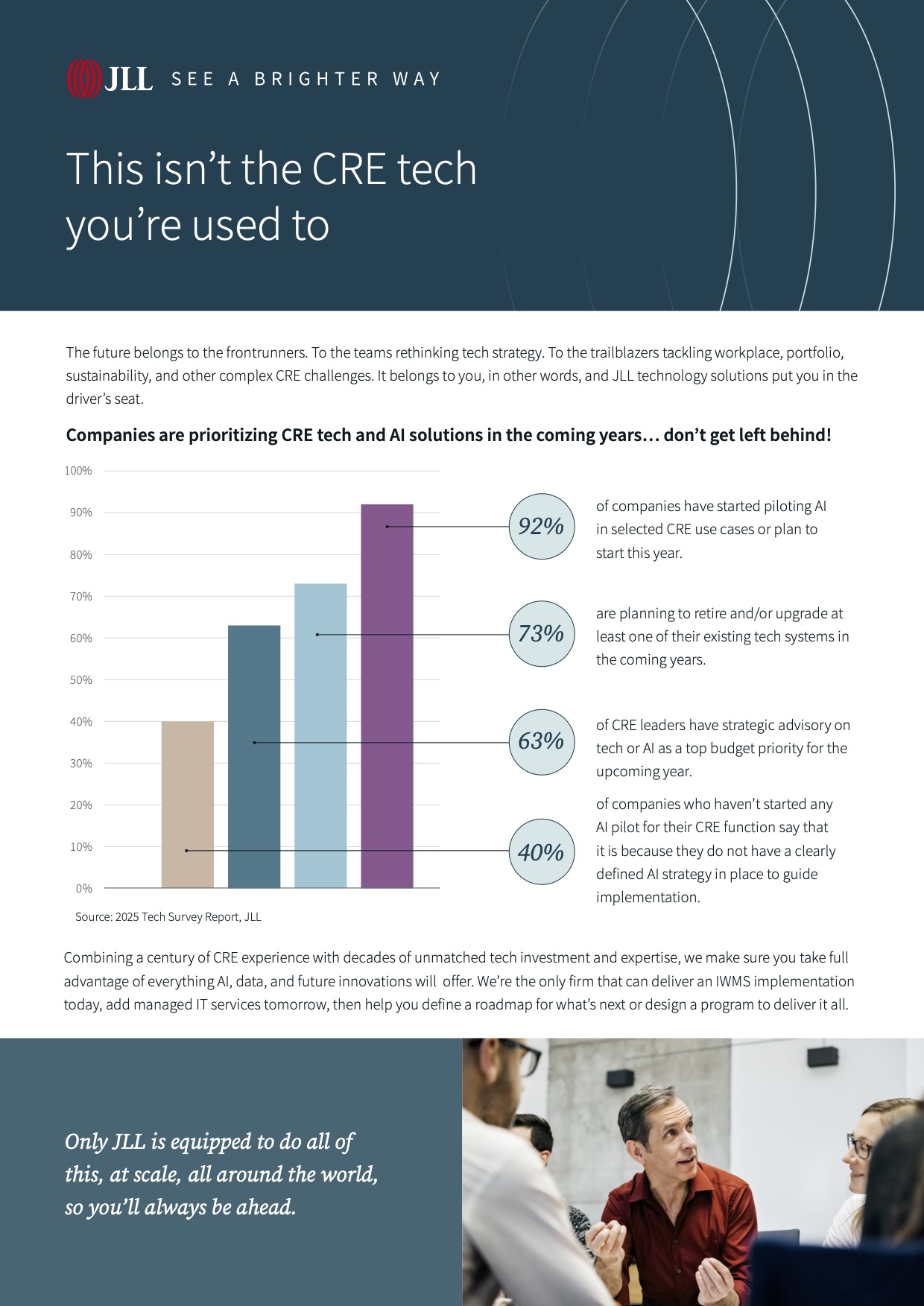
The view from the other end of the telescope

There is ample space in the market for disruptors with a different language and mindset. The future of FM belongs not only to the large and complex, but to the agile, the human‑centred and the value‑driven.

Author: Martyn Freeman, CEO, Q3 Services

The UK facilities management industry stands at a pivotal moment. While the market has grown and evolved, the sector’s increasing complexity has created a widening gap between what some large providers deliver and what many clients truly need. This article explores the FM landscape from the perspective of a challenger organisation - Q3, founded by leaders who have experienced both the scale of major FM corporations and the agility of a new entrant.

For this article, I have drawn on real-life examples to demonstrate how smaller, highly responsive FM providers can deliver value through personalised service models, empowered people, modern flexible technology and a renewed focus on fundamentals that the industry too often overlooks.

I share some insights gained from building an FM organisation from scratch, seeing the industry from the ‘other end of the telescope’ and understanding the gaps between large‑scale FM delivery and the needs of modern clients.

Launching a new FM enterprise immediately exposed the realities faced by SMEs.

The history
After 30 years in FM, working for some of the biggest organisations in the industry, I took the opportunity in 2018 to start something entirely new: a challenger brand based in the Thames Valley with a clear vision of doing things differently. What followed was a rapid, unexpected journey that revealed a great deal about how the FM sector functions and where it needs to change.

Starting from zero: a new perspective
Launching a new FM enterprise immediately exposed the realities faced by SMEs:

  • We had no credit history. Even simple things like sourcing a phone contract became a challenge.
  • Long‑term suppliers from previous relationship suddenly became disinterested.
  • Former clients were reluctant to engage now that the logos and scale had disappeared.
  • Previous corporate status offered no leverage in a small‑business environment.

The instant loss of ‘big-company kudos’ demonstrated how deeply the industry (wrongly) equates size with capability. However, for the new management team, it reinforced the value of agility, flexibility and quality over scale - principles that shaped Q3 from the outset.

The Q3 strategy
Our growth strategy focused on three pillars:

  1. Employing quality people
  2. Delivering quality services
  3. Working with quality clients to create quality workplaces.

This simple philosophy is the origin of the Q3 name and remains central to our approach today.

Ironically, outsourcing has evolved into a system burdened by its own complexity.

FM today: a market of complexity and contradictions
The FM market is vast, diverse and increasingly dominated by large organisations. Ironically, outsourcing, which was originally created to simplify operations and improve cost‑effectiveness, has evolved into a system burdened by its own complexity.

Large providers have created what might be termed ‘oil tanker syndrome’:

  • Slow to turn
  • Heavy internal governance
  • Standardised models driven by corporate needs rather than client needs
  • Inherent inflexibility
  • Increasingly distant from front‑line reality.

As the big become bigger through mergers and acquisitions, SMEs must differentiate rather than imitate.

Know your client sweet-spot and stick to it.

Competing as a challenger FM provider
Realistically, SMEs cannot, and should not, attempt to win the Barclays of this world. Likewise, major FM organisations rarely need to pursue small £3m‑scale contracts. The market segmentation is clear – know your client sweet-spot and stick to it.

Successful challenger providers focus on:

  1. Selective targeting

Choosing clients whose needs align with SME strengths:

  • Agility
  • Customisation
  • High‑touch service
  • Direct senior involvement. 

  1. Value‑based differentiation

Competing on value, not volume. For SMEs, this means building contracts around the client rather than offering off‑the‑shelf solutions. A notable example is our partnership with Catapult where the client’s post-tender feedback was: You didn’t tell me how I should fit into your box; you showed how you would fit into ours.”

This approach strengthens relationships, builds trust and creates long‑term retention.

  1. Senior leadership visibility

Unlike larger organisations, we maintain direct board‑level engagement throughout the life of every contract. Senior leaders regularly visit sites, meet clients and speak with frontline colleagues. Clients know they can call us directly and get a solution immediately.

And because we don’t have layers of off-the-bench resources waiting in the background, every new contract demands that we hire the right person specifically for that client. Decisions are always guided by what will serve the client best.

The supply chain and the SME challenge
Many small FM providers rely heavily on subcontracting models, working for the larger property & FM companies. While common, this introduces challenges:

  • Managing agents become the ‘client’, limiting direct relationships
  • Risk increases
  • Innovation is stifled
  • Intellectual property can be lost
  • Providers have no access to client decision‑makers
  • SMEs can be disproportionately affected by failures in the chain, as seen with the Carillion collapse.

Q3 deliberately avoids dependence on subcontracting for core delivery. When we work with partners, they are locally selected, locally coordinated and part of a cohesive value‑creating model, not an outsourced commodity layer.

FM is, and always has been, a people industry.

People first: the core of FM
Yes, it’s a cliché, but FM is, and always has been, a people industry. While technology and data are evolving rapidly, frontline expertise remains the most powerful driver of service quality.

We champion a genuine, people-first approach:

  • Recognising talent within the business and supporting career growth
  • Bringing in high‑skilled individuals from outside FM to enrich our capability
  • Listening closely to frontline colleagues whose insights often reveal the most valuable improvements.

One of the most impactful examples is hiring a young data analyst with no prior FM experience to administer and develop our CAFM platform, Facilio. We received over 200 applications for the role, and he was one of a handful with no FM sector experience. But we hired him because his analytical skills transformed the contract’s performance, demonstrating how cross‑industry talent can elevate FM delivery.

Once people are in the FM sector and understand it, we are great at developing careers in different directions within our organisation. In our senior leadership, we have a finance director who used to be a personal assistant and an HR director who used to head up bid management.

In an interesting example of reciprocal trading, we also partner with employability programmes such as the Restart Scheme through our client Maximus to bring new talent and opportunity into the sector.

Technology: pragmatic, not flashy or tech for tech’s sake
FM organisations frequently promote technology as a game‑changer. Everyone has worked themselves into a frenzy over the possibilities of AI. But too often, the rhetoric exceeds the reality.

Q3 takes a pragmatic, value‑focused approach:

  • We invest in modern, flexible CAFM platforms rather than expensive legacy systems
  • Our systems adapt to each client instead of forcing clients to fit a preset model
  • Data belongs to the client - we are custodians, not owners. At the end of the contract, they keep it
  • Integration with client systems is simple and seamless.

Technology is only valuable when it directly enhances service quality, responsiveness and decision‑making,and that’s our philosophy before we scope out any tech solution on a contract.

The industry challenge: profile and perception
FM continues to struggle with visibility and recognition. This limits its influence at board level, reduces its perceived value and hinders its ability to attract talent.

Part of the issue is that the industry undersells its fundamentals - the essential services that keep organisations functioning. There is too much focus on buzzwords, technology and new shiny things at the expense of any pride in core delivery.

To move forward, the industry needs a stronger, more unified voice. We must advocate for the value FM brings to UK plc and celebrate the successes that often go unrecognised.

To move forward, the industry needs a stronger, more unified voice.

Conclusion
Viewing FM from both ends of the telescope - the scale of major corporations and the agility of SMEs - provides powerful insights into how the industry must evolve.

Challenger organisations like Q3 will succeed by:

  • Staying flexible
  • Designing services around the client
  • Empowering people
  • Using technology with purpose
  • Retaining senior visibility
  • Being bold enough to do things differently.

There is ample space in the market for disruptors with a different language and mindset. The future of FM belongs not only to the large and complex, but to the agile, the human‑centred and the value‑driven.


Download Presenter Slides

Potential exists everywhere. Opportunity does not.

Technology will undoubtedly transform workplaces over the coming decade.  But the organisations that thrive will be those that recognise something equally important: the future workplace will depend on access to human potential.

Author: Debbie Dobson, Talent & Capability Director, ISS UK & Ireland

Conversations about the future workplace often focus on technology - artificial intelligence, smart buildings, automation, digital optimisation.  These innovations will undoubtedly shape how workplaces operate.

But they raise an important question. What is a workplace without people?

No matter how sophisticated a building becomes, someone still must walk through the door. Someone still must maintain it, lead within it, and ultimately feel that they belong there.  The future workplace may be enabled by technology - but it will ultimately be defined by people.

For organisations operating at scale, this raises a more fundamental challenge: where will the workforce of the future come from?

Where will the workforce of the future come from?

The workforce challenge behind workplace futures
Across many industries, organisations are facing a convergence of pressures:

  • Persistent skills shortages in technical roles
  • Changing demographics affecting labour supply
  • Rising expectations around opportunity and inclusion
  • Increasing competition for talent.

At ISS, we employ around 350,000 colleagues worldwide. That scale gives us a unique perspective on the workforce question.

When you operate with a workforce of that size, you are not simply filling jobs.  You are shaping skills pipelines.  You are shaping career pathways.  And, increasingly, you are shaping access to opportunity.

Every decision - from how candidates are sourced and assessed, to how apprenticeships are designed, to how careers are developed - becomes a lever that can either preserve existing barriers or remove them.

At that scale, social mobility cannot sit on the sidelines as a philanthropic initiative.  It becomes workforce strategy.

Potential is universal. Opportunity is not.
Our approach begins with a simple belief: potential exists everywhere; opportunity does not.

For many organisations, traditional recruitment practices still rely heavily on signals that reflect previous opportunity - qualifications, networks, polished CVs, conventional career paths.  These systems were designed in different times and often reward familiarity and confidence as much as capability.  Even the most advanced technology will only replicate those filters if they remain embedded in the system.

For organisations thinking seriously about the future workforce, this raises a critical question:

are we actually missing the talent we need?

When ISS began expanding partnerships with organisations supporting refugees, young people, disability groups and those experiencing homelessness, something became immediately clear.  The issue was not a lack of talent.  The issue was a lack of access.

The issue was not a lack of talent.  The issue was a lack of access.

Social mobility as strategy, not programme
At ISS UK&I, this realisation led to a fundamental shift.  Social mobility would not sit alongside our business strategy.   It would become part of the strategy itself.

We brought this thinking together under what we call Mission Possible - our approach to widening access to opportunity. 

But Mission Possible is not designed as a standalone programme. It is designed as a principle embedded into the way the organisation operates.  That means thinking differently about:

  • How we hire
  • How we assess potential
  • How vetting processes work
  • How development pathways are created
  • And how leaders open doors for others

When access to opportunity becomes built into these processes, the impact becomes consistent, scalable, long‑lasting and measurable.

What this looks like in practice
This shift has very tangible implications.

One area is skills development.  Across ISS, we have more than 500 apprentices at any one time, with a deliberate focus on areas where the labour market itself presents challenges, such as engineering talent, and where we know we have to build capability for future growth of the business such as leadership development and data capability. Apprenticeships are designed not simply as entry routes, but as pathways into skilled careers.

Another dimension is access to employment itself.  In 2025 alone, ISS recruited over 300 individuals from disadvantaged backgrounds, including refugees and people who had experienced homelessness. In some cases, this required challenging traditional vetting assumptions around accommodation and employment history - recognising that potential does not always present itself through conventional CVs.

In addition, beyond the walls of our own business, ISS supports employment placements annually for young people with disabilities, with conversion rates into employment of around 80% in some sectors.

These examples illustrate a broader point: when organisations widen the gateway to opportunity, they often discover talent that was previously invisible through traditional approaches.

The future workforce is shaped long before someone applies for a job. 

Strengthening the wider opportunity ecosystem
Social mobility also extends beyond organisational boundaries.  In 2025, ISS gifted £1.6 million of apprenticeship levy funding to external organisations working with disadvantaged young people, disability groups and homelessness support services.

This reflects an important insight: the future workforce is shaped long before someone applies for a job.  If organisations want resilient talent pipelines, they need to support the ecosystems that enable opportunity in the first place.  In that sense, workforce strategy increasingly becomes ecosystem strategy.

Why widening opportunity matters for the future workplace
For organisations thinking about workplace futures, widening access to opportunity delivers clear strategic advantages.  When opportunity expands:

  • Engagement increases
  • Retention improves
  • Skills shortages become easier to address
  • Leadership pipelines diversify
  • Innovation improves
  • Organisational resilience strengthens.

Ultimately, organisations create a workforce ready for the future.

Technology will undoubtedly transform workplaces over the coming decade.  But the organisations that thrive will be those that recognise something equally important: the future workplace will depend on access to human potential.

If potential exists everywhere - and evidence suggests it does - then the organisations that succeed will be those that choose to widen the gateway.

At ISS, Mission Possible represents our commitment to doing exactly that: embedding social mobility into workforce strategy and using the scale of a global employer to create pathways for progress.

Because ultimately, the workplaces of the future will not simply be designed by technology.

They will be built by people.


Download Presenter Slides

Watch Recorded Presentation
Acknowledgements


www.i-FM.net

Workplace Futures is organised each year by i-FM, the award-winning web-based news and information service catering to the needs of the facilities management community. With a reputation for top-quality news, features, comment and research, we have grown and developed with the industry - always maintaining our distinctive focus on the FM marketplace. Updated every business day, the site delivers a unique service - easily accessible, fully searchable and highly topical. The pioneer when it was established in 1999, i-FM is still the only online resource an FM needs.

www.workplace-futures.co.uk
Each Workplace Futures conference programme since the launch of the series in 2007 has tackled a different issue in the FM sector; but an underlying theme throughout has been the comparatively low 'name recognition' that continues to characterise facilities management, along with the associated tendency toward under-appreciation of the value it both represents and contributes to UK plc. The goal of the conference series, and each post-event White Paper, is to address these challenges by fostering education, discussion and positive action that supports the growth and development of FM.
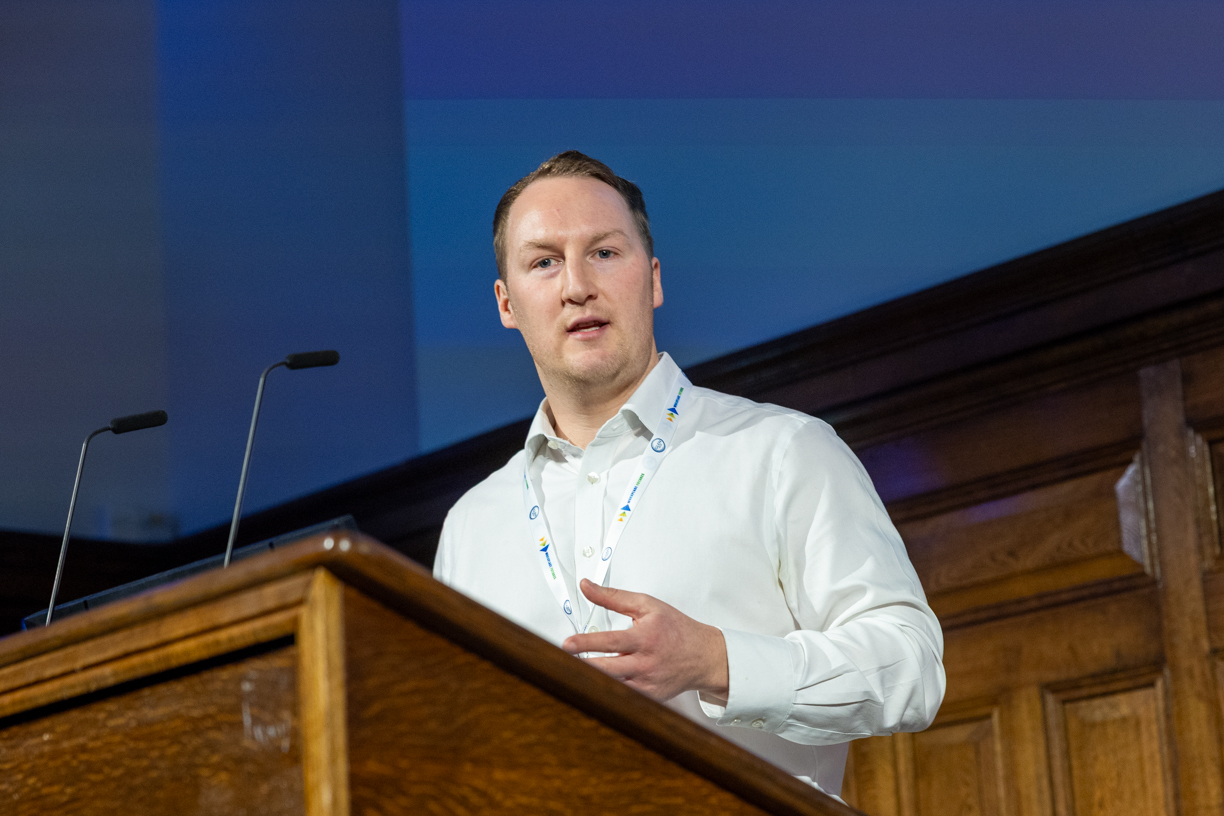


© Workplace Futures 2026 / i-FM.net · FM - a roadmap to the future · For permissions: info@i-fm.net